

Understanding the 5S LiPo Battery Advantage in FPV
The transition from 4S to 5S LiPo battery configurations represents one of the most significant shifts in modern FPV flying. While 4S batteries have dominated the freestyle and racing scenes for years, 5S packs offer a compelling voltage advantage that translates directly into performance gains. A fully charged 5S LiPo battery delivers 21 volts compared to 16.8 volts from a 4S pack, providing approximately 25% more electrical power to your motors and flight controller systems.
This voltage increase isn’t just about raw numbers – it fundamentally changes how your quad responds throughout the entire flight. Higher voltage means your motors maintain consistent power output even as the battery discharges, reducing the dreaded voltage sag that causes performance drops during aggressive maneuvers. For freestyle pilots pushing their quads through demanding tricks and high-current draws, this sustained power delivery can mean the difference between landing that perfect gap or experiencing a disappointing power fade mid-trick.
Voltage Sag: The Hidden Performance Killer
Voltage sag occurs when your LiPo battery cannot maintain its nominal voltage under high current loads, causing temporary voltage drops that directly impact motor performance. With 4S batteries, pilots often experience noticeable power reduction during punch-outs or aggressive maneuvers as the pack voltage drops from 16.8V to 14V or lower. This phenomenon becomes more pronounced as the battery discharges, creating an inconsistent flying experience where early-flight performance doesn’t match end-of-pack behavior.
5S LiPo batteries combat voltage sag through their higher baseline voltage, providing a larger voltage buffer before performance degradation becomes noticeable. Even when a 5S pack experiences similar voltage drops under load, the absolute voltage remains higher than a 4S equivalent, maintaining motor efficiency and throttle response. This translates to more consistent flight characteristics from takeoff to landing, allowing pilots to maintain aggressive flying styles throughout the entire battery cycle without compensating for diminishing power output.

Real-World Voltage Performance Comparison
Testing reveals dramatic differences between 4S and 5S voltage behavior under identical flight conditions. During high-current maneuvers, a typical 4S 1500mAh pack might sag from 16.8V to 13.5V, representing a 20% voltage drop that directly correlates to reduced motor power. The same maneuver with a 5S 1300mAh pack shows voltage sag from 21V to approximately 17.5V – still delivering more voltage than a fresh 4S pack at rest. This performance advantage becomes even more pronounced as batteries age, with 5S packs maintaining superior voltage delivery long after 4S equivalents begin showing significant degradation.
Motor KV and 5S LiPo Battery Compatibility
Switching to 5S LiPo batteries requires careful consideration of motor KV ratings to avoid damaging your equipment or creating unsafe operating conditions. Motors designed for 4S operation typically feature KV ratings between 2300-2700, but these same motors on 5S power would spin significantly faster, potentially exceeding safe RPM limits and generating excessive heat. The relationship between voltage and motor speed is linear – a 2500KV motor on 4S reaches approximately 42,000 RPM at full throttle, while the same motor on 5S would attempt to reach 52,500 RPM.
For optimal 5S performance, pilots should select motors with KV ratings between 1900-2200 to maintain similar RPM ranges while benefiting from the voltage advantages. This lower KV requirement doesn’t represent a performance compromise – the higher voltage more than compensates for the reduced KV, delivering superior power output with improved efficiency. Many motor manufacturers now offer specific 5S-optimized variants of popular models, featuring appropriate KV ratings and enhanced magnets designed to handle the increased electrical stress of higher voltage operation.
Calculating Optimal Motor KV for 5S Systems
Determining the correct motor KV for your 5S setup involves understanding your desired RPM range and prop requirements. For freestyle flying with 5-inch props, target RPM ranges typically fall between 40,000-45,000 for optimal performance and motor longevity. Dividing your target RPM by 21 volts (5S nominal voltage) provides the ideal KV rating – for 42,000 RPM operation, a 2000KV motor proves optimal. Racing applications might benefit from slightly higher KV motors (2100-2200) for increased top-end speed, while cinematic flying often favors lower KV options (1800-1900) for smoother throttle response and extended motor life.
Flight Time Analysis: 5S vs 4S Performance
Flight time comparisons between 5S and 4S LiPo batteries reveal surprising results that challenge common assumptions about battery capacity and flight duration. While 5S packs typically offer lower mAh ratings than their 4S counterparts due to the additional cell, the improved efficiency and reduced current draw often result in comparable or superior flight times. A 1500mAh 4S pack might provide 4-5 minutes of aggressive freestyle flying, while a 1300mAh 5S pack frequently delivers 4.5-5.5 minutes under identical conditions.
This performance advantage stems from the relationship between voltage, current, and power consumption. Higher voltage allows motors to produce equivalent power at lower current levels, reducing the stress on both the battery and electronic speed controllers. Additionally, the reduced voltage sag characteristics of 5S packs mean pilots can maintain aggressive flying styles throughout the entire flight without experiencing the power fade that forces throttle compensation with 4S systems. The result is more consistent performance and often longer usable flight times despite the lower capacity rating.
Weight Considerations and Power-to-Weight Ratios
The additional cell in 5S LiPo batteries does add weight compared to equivalent 4S packs, but this increase is often offset by the ability to use smaller capacity batteries while maintaining similar flight times. A typical 1500mAh 4S pack weighs approximately 180-200 grams, while a 1300mAh 5S equivalent weighs 190-210 grams – a minimal difference that’s easily compensated by the performance gains. More importantly, the superior power delivery of 5S systems often allows pilots to achieve better power-to-weight ratios, as the quad can generate more thrust per gram of total aircraft weight, improving acceleration and maneuverability.
Top 5S LiPo Battery Recommendations for FPV
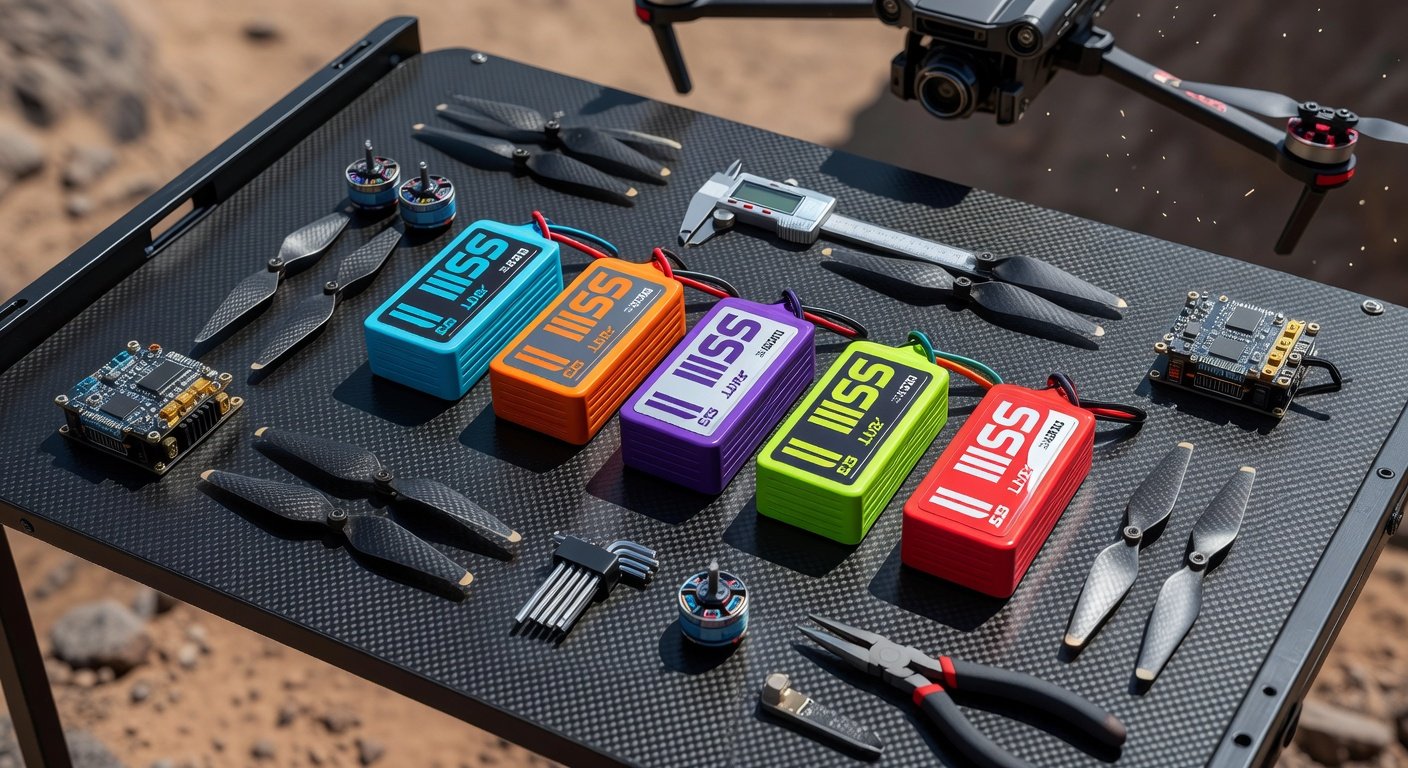
Selecting the right 5S LiPo battery requires balancing capacity, discharge rate, and build quality to match your flying style and aircraft requirements. The Tattu R-Line 5S 1300mAh 120C stands out as an excellent all-around choice, offering exceptional discharge capabilities and consistent voltage delivery throughout the flight cycle. For pilots prioritizing maximum flight time, the GNB 5S 1500mAh 100C provides additional capacity while maintaining excellent performance characteristics and competitive pricing.
Racing pilots often gravitate toward the CNHL 5S 1100mAh 100C for its lightweight design and explosive power delivery, while freestyle pilots appreciate the Turnigy Graphene 5S 1300mAh 65C for its balanced performance and value proposition. For pilots seeking premium performance regardless of cost, the Thunder Power 5S 1350mAh 130C delivers unmatched voltage stability and cycle life, though at a significant price premium. Each of these options offers distinct advantages depending on your specific requirements and budget constraints.
Capacity Selection Guidelines for Different Flying Styles
Choosing the optimal 5S capacity depends heavily on your flying style and aircraft configuration. Racing pilots typically benefit from 1000-1200mAh packs that minimize weight while providing sufficient power for short, intense flights. Freestyle pilots often prefer 1300-1400mAh batteries that balance flight time with maneuverability, allowing for extended practice sessions without excessive weight penalties. Long-range or cinematic applications might justify 1500-1600mAh packs despite the weight increase, as the extended flight time outweighs the performance impact for these specific use cases.
Making the Switch: Essential Considerations
Transitioning from 4S to 5S LiPo batteries involves more than simply purchasing new packs – it requires systematic evaluation of your entire power system to ensure compatibility and safety. Your electronic speed controllers must be rated for 6S operation (which covers 5S use) to handle the increased voltage without damage. Most modern ESCs support this voltage range, but older 4S-specific controllers may require replacement. Additionally, verify that your flight controller and other electronics can handle 5S input voltage, though most current systems support wide voltage ranges that accommodate both 4S and 5S operation.
Charging infrastructure also requires attention when switching to 5S systems. Your charger must support 5S charging profiles, and you’ll need appropriate balance leads and charging cables. Many pilots find that 5S batteries require slightly longer charging times due to the additional cell, so factor this into your flying schedule. Storage and transport considerations also change slightly, as 5S packs store more total energy and require appropriate fireproof storage solutions. Finally, consider gradually transitioning your battery collection rather than switching entirely at once, allowing you to compare performance directly and adjust your setup incrementally.
Frequently Asked Questions
Can I use my existing 4S charger for 5S LiPo batteries?
Only if your charger specifically supports 5S charging profiles. Most modern multi-chemistry chargers handle 1S-6S configurations, but older 4S-specific chargers cannot safely charge 5S packs. Check your charger’s specifications before attempting to charge 5S batteries.
Will 5S batteries damage my 4S-rated ESCs?
Yes, 4S-specific ESCs cannot handle 5S voltage levels and will likely be damaged. You need ESCs rated for at least 6S operation to safely use 5S batteries. Most modern ESCs support wide voltage ranges, but always verify compatibility before connecting.
Do 5S batteries provide longer flight times than 4S?
Often yes, despite lower capacity ratings. 5S batteries typically offer 10-20% longer flight times due to improved efficiency and reduced voltage sag, allowing motors to operate more efficiently throughout the discharge cycle.
What motor KV should I use with 5S LiPo batteries?
For 5-inch freestyle quads, 1900-2200 KV motors work best with 5S batteries. This is lower than typical 4S motors (2300-2700 KV) but provides similar RPM ranges while benefiting from higher voltage efficiency.
Are 5S batteries more dangerous than 4S?
5S batteries store more energy and operate at higher voltages, requiring proper handling and storage. However, when used with compatible equipment and proper safety practices, they’re no more dangerous than 4S batteries. Always use appropriate fireproof storage and charging practices.
Ready to Experience 5S Performance?
Making the switch to 5S LiPo batteries can transform your FPV flying experience with improved power delivery and flight times. Before you upgrade, ensure your entire system is compatible and consider starting with one or two packs to test the difference. Need help selecting the right 5S setup for your specific aircraft and flying style? Our FPV experts can guide you through the transition process and recommend the optimal components for your upgrade.