
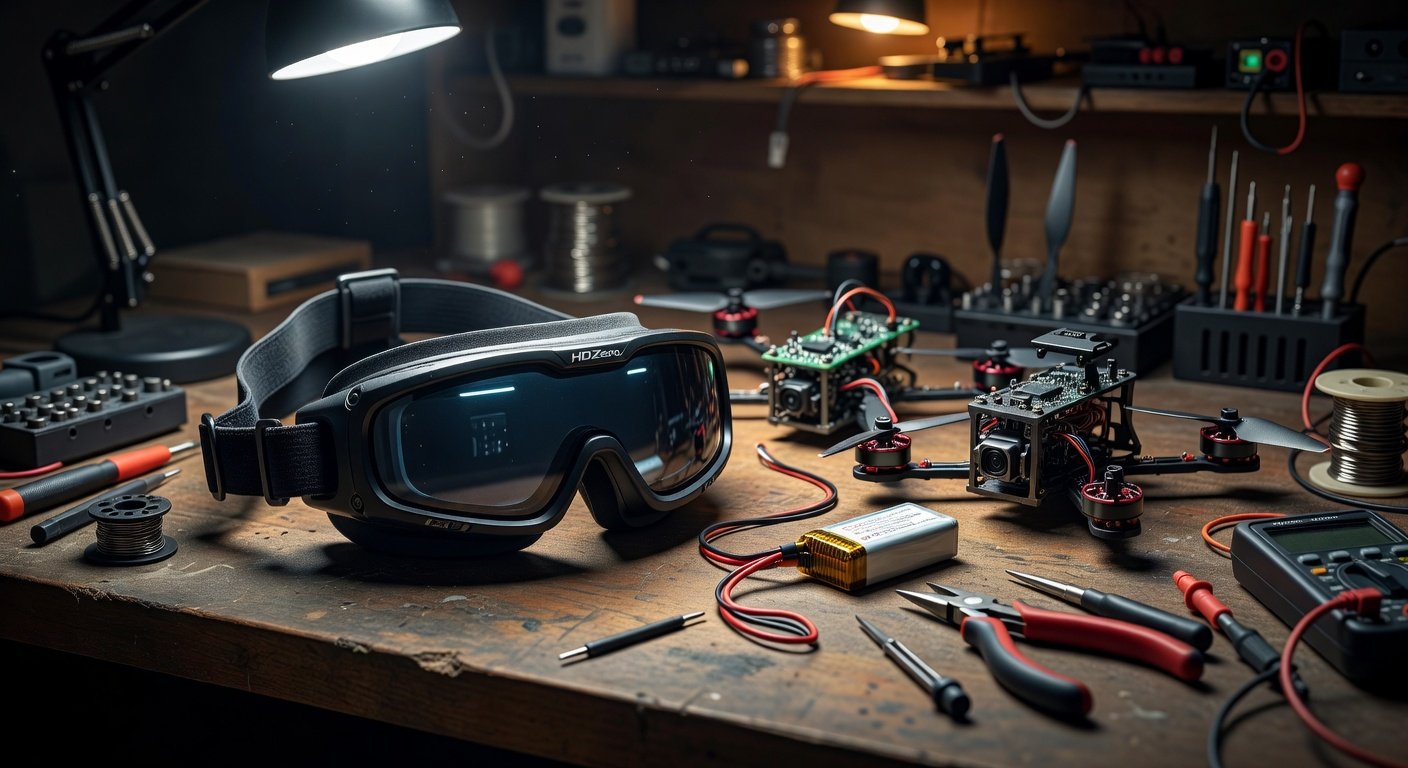
HDZero: Ditching Analog Headaches for Digital Clarity
Let’s get straight to it: HDZero goggles fundamentally shift how FPV pilots experience their craft, moving past analog’s unpredictable video feed. Forget the traditional 5.8GHz fuzz and dropouts; HDZero operates on a proprietary digital protocol, engineered specifically for the FPV racing and freestyle crowd. If your video has ever pixelated or cut out mid-gap, you know the frustration. HDZero tackles this with remarkably low latency and robust signal. It pairs dedicated HDZero VTX modules on your quad with a built-in receiver in the goggles, creating a solid link optimized for performance and reliability. Plus, integrated DVR means cleaner footage without needing extra external recording gear.
The digital vs. analog debate has been a hot topic for years, but HDZero makes you genuinely rethink the tradeoffs. Sure, analog systems are cheaper upfront, incredibly versatile, and raw RF latency is practically instantaneous in ideal conditions. However, analog hits a wall with frequency crowding, WiFi interference, and signal degradation over distance. HDZero largely sidesteps these headaches with digital encoding and error correction. But it’s not a free lunch; you’ll need specific camera modules and factor in a higher initial cost. For any pilot building a new rig or eyeing an upgrade, understanding these pros and cons is essential before committing to the HDZero ecosystem.
Specs That Fly: HDZero’s Technical Performance
The current HDZero goggles (as of 2024) pack some serious punch, directly addressing common FPV frustrations. We’re talking end-to-end latency consistently around 60-80 milliseconds, which is right there with DJI O3 systems and a massive leap over analog’s often variable, higher latency when things get messy. This low delay is absolutely critical for competitive racing and precise freestyle, where even 100ms of lag can throw off your muscle memory and make quick maneuvers feel sluggish. The display itself boasts a sharp 1280×960 resolution at a crisp 60Hz refresh rate, delivering video that’s noticeably clearer than any analog feed, especially when you’re moving fast and need to minimize motion blur during aggressive maneuvers.
Beyond the display, these goggles feature 48dB of integrated diversity reception. What that means for us pilots is it’s constantly scanning and picking the strongest signal from multiple antennas, a huge advantage when you’re battling RF interference or flying in tricky spots. Powering all this is a robust built-in 4000mAh battery, giving you a solid 90-120 minutes of flight time, plenty for a full afternoon session without worrying about swapping packs. Camera compatibility is flexible: it works with any standard NTSC or PAL FPV camera. You just need an HDZero camera module (Runcam or Foxeer, typically $40-60) to convert the analog output to digital. The VTX modules themselves are compact at 5-8 grams, fitting easily on most racing and freestyle frames.
Cost, Ecosystem, and Real-World Flight Experience
Let’s talk brass tacks: the cost of going HDZero is a major consideration. You’re looking at roughly $300-400 for the goggles alone, plus another $60-100 for a VTX module, and then $40-60 for a compatible camera module. Compare that to a decent analog setup which is significantly cheaper upfront. However, this math changes when you consider real-world usage. Analog pilots in crowded areas often buy multiple VTXs to avoid frequency clashes; HDZero eliminates this entirely. Its proprietary digital protocol means multiple HDZero quads can fly without video conflicts, saving hidden costs and frustration. Plus, integrated DVR is a huge bonus for content creation and reviewing your lines.
Flying with HDZero goggles feels distinctly different from analog, and most pilots report an immediately positive transition. The crisp, stable video feed genuinely boosts situational awareness, whether you’re ripping through a dense forest or navigating an urban environment. That consistent 60-80ms latency means your stick inputs feel incredibly responsive and predictable – no frustrating lag between your command and the quad’s reaction. Racers will find faster lap times and more confidence for aggressive lines. Freestyle pilots appreciate the clarity for hitting precise acrobatic maneuvers, as the sharp image makes judging orientation and distance far easier. The integrated DVR also captures high-quality footage of your flights, ready for immediate review.
The big question is whether HDZero is for you. If you’re a competitive FPV racer, a content creator, or frequently fly multiple quads in populated areas, HDZero’s advantages stack up, justifying the investment. Eliminating frequency coordination is a massive win for group sessions or organized races. Conversely, if you’re a casual weekend flyer with a single quad in an interference-free zone, analog might be the smarter, more economical choice. HDZero locks you into its ecosystem, though it integrates perfectly with your existing Betaflight FC and ESCs. The choice comes down to your priorities: performance and convenience for serious pilots, or budget and wide compatibility for casual flyers.
Quick Facts
- •💡 HDZero goggles use a proprietary digital protocol for video transmission, unlike analog 5.8GHz systems, eliminating frequency interference issues.
- •💡 The system delivers a consistent 60-80ms end-to-end latency and features a 1280×960, 60Hz display, powered by a 4000mAh battery for 90-120 minutes of flight.
- •💡 For FPV pilots, this translates to snappier control response, clearer situational awareness, and the ability to fly multiple quads simultaneously without video conflicts.
- •💡 HDZero requires specific camera modules (around $40-60) to convert analog camera output to digital, and lightweight VTX modules (5-8g) which integrate with standard Betaflight flight controllers.
- •💡 While the upfront cost is higher ($200-250 more than analog), it’s often justified for competitive racers and content creators due to superior performance and integrated DVR recording.