
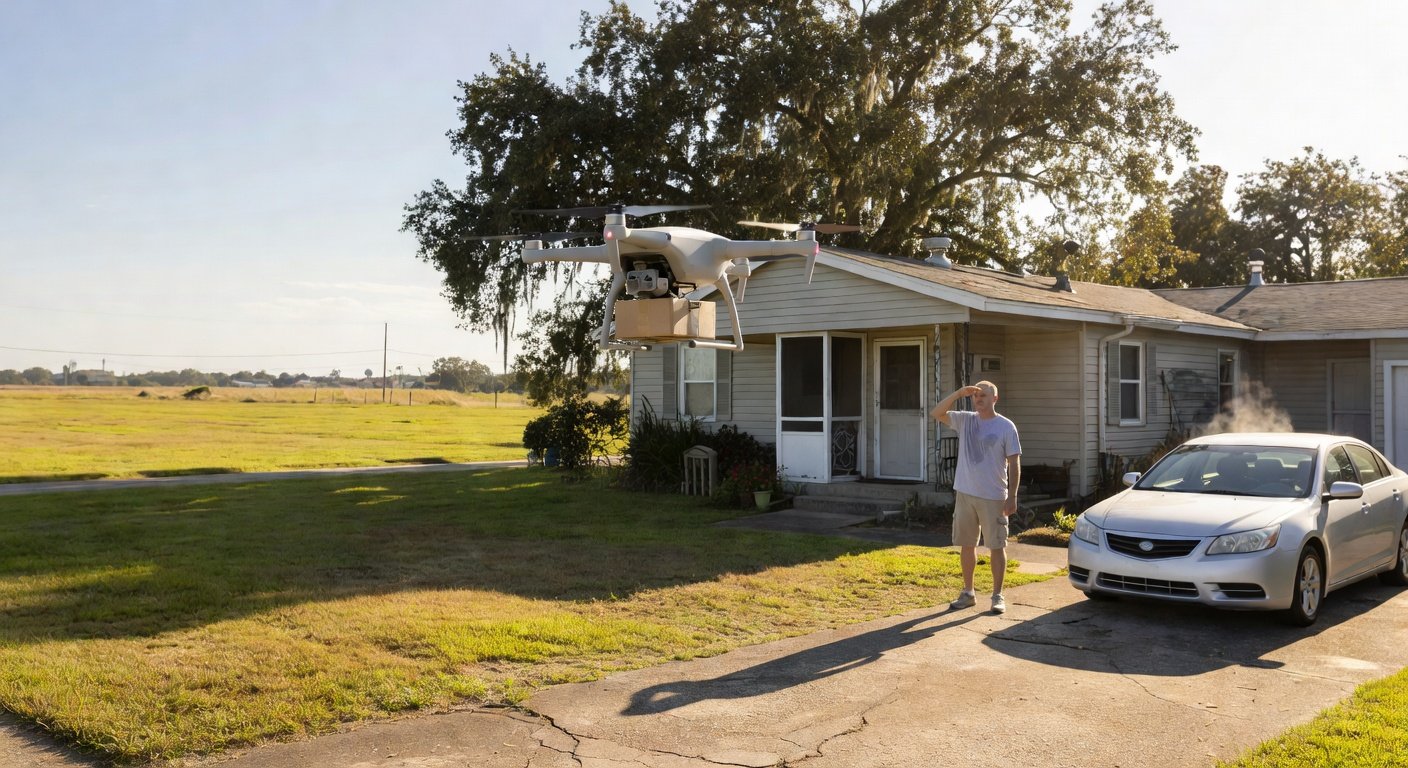
MK30 Deployment in Baton Rouge: Specs and Operational Realities
Amazon’s Prime Air is gearing up to launch MK30 drone deliveries in Baton Rouge, Louisiana, this summer, deploying between 12 and 20 of these hefty hexacopters from a new facility adjacent to their existing Cortana fulfillment center. This service aims to drop packages up to 5 pounds (2.3 kg) within a 7.5-mile (12.1 km) radius. For Prime members, it’s a $4.99 per delivery charge, while non-Prime customers will pay $9.99. This rollout continues Amazon’s aggressive expansion across the US, adding Baton Rouge to a growing list that includes Texas, Michigan, Arizona, Florida, and Kansas, all while the MK30’s safety record remains under scrutiny.
The MK30 isn’t some tiny cinewhoop; it’s an 83-pound hexacopter featuring a fixed-wing element, which is a significant piece of kit for a relatively small 5-pound payload. From a builder’s perspective, that weight-to-payload ratio immediately flags the design choices Amazon has made, unlike competitors like Wing or Zipline. These drones cruise at altitudes above 200 feet (61 m) and speeds over 70 mph (113 km/h), capable of operating in light rain. Once it reaches the delivery point, the MK30 descends to approximately 12 feet (3.7 m) before releasing the package. Customers pre-select up to three drop zones on their property, with Amazon advising a 10-foot clear zone for safety, keeping people, pets, and tall objects clear of the drop area. Roughly 60,000 products from Amazon’s catalog are eligible for drone delivery in the area.
Prime Air’s Rapid Expansion Amidst Ongoing Incidents
Jeff Cleland, Amazon’s principal of Prime Air drone delivery, announced the Baton Rouge plan on April 22, 2026. This launch follows a swift expansion cadence since Amazon recovered from a January 2025 grounding incident. New facilities have opened rapidly, including Pontiac and Waco in November 2025, Hazel Park later that month, Richardson, Texas, in December 2025, and Kansas City in February 2026. Baton Rouge marks the program’s first Gulf Coast metro outside Florida, and Amazon is already eyeing Chicago suburbs and Atlanta, where Walmart’s partner Wing already has a foothold. This rapid scaling is crucial for Amazon, as internal projections show a delivery cost of around $63 per package, making volume essential to close the gap with customer pricing and hit their ambitious target of 500 million annual deliveries by 2030.
Despite this push for expansion, the MK30’s safety record is a critical concern for the FPV community and the public. In December 2024, two MK30s crashed at Amazon’s Oregon testing facility due to faulty LiDAR sensors mistaking rain for the ground, leading to a temporary grounding in January 2025 until FAA-approved software fixes were implemented in March 2025. Post-fix incidents include two separate MK30s striking the same construction crane in Tolleson, Arizona, in October 2025, an internet cable severed in Waco, Texas, in November 2025, and a collision with an apartment building wall in Richardson, Texas, in February 2026. The bystander account from Richardson, describing propellers still moving and a burning smell, highlights the real-world impact of these incidents, even if firefighters confirmed no fire broke out.
Community Impact and Regulatory Scrutiny
The push into Baton Rouge is framed by Amazon as catering to an “innovative town” that embraces new technology, echoing their strategy in other launch cities. This approach, involving pre-launch community events and careful engagement with local officials, directly addresses past issues like noise complaints in College Station that forced Amazon to pull back. However, Baton Rouge presents a fresh challenge: the severe afternoon convective storms common in Louisiana summers. While the MK30 is certified for light rain, the specific conditions of a hot, humid Gulf Coast environment with unpredictable weather patterns will genuinely test its operational limits, particularly its upper-bound thermal envelope, which has received less attention than its 14°F (-10°C) lower limit.
For the FPV community, the overarching implication of Prime Air’s aggressive expansion and its safety incidents lies in the regulatory landscape. Every MK30 crash or close call, especially those occurring in public airspace rather than restricted test facilities, contributes data that will shape the FAA’s pending Part 108 BVLOS (Beyond Visual Line of Sight) rulemaking. This rule is set to define the future of commercial drone operations nationwide. The current gap, where mandatory incident-reporting requirements might not capture every near-miss, leaves many questions. How the FAA interprets this real-world operational data, and whether a future Part 108 mandates comprehensive reporting, will significantly influence not only Amazon’s operations but also the broader regulatory environment for all commercial and even hobbyist drone pilots, impacting everything from flight zones to public perception.
Quick Facts
- •💡 Amazon Prime Air will launch MK30 drone deliveries in Baton Rouge, Louisiana, this summer, from a new facility near the Cortana fulfillment warehouse.
- •💡 The MK30 is an 83-pound hexacopter with a fixed-wing element, designed to deliver packages up to 5 pounds (2.3 kg) within a 7.5-mile (12.1 km) radius.
- •💡 The ongoing incidents, including crashes into a construction crane, an internet cable, and an apartment building, highlight the technical challenges and public safety considerations for large-scale drone operations.
- •💡 Amazon aims for 500 million annual drone deliveries by 2030, a significant jump from the roughly 16,000 deliveries logged by February 2026, indicating a massive scaling effort.
- •💡 The operational data generated by Prime Air’s expansion, particularly concerning safety incidents and weather performance, will directly influence the FAA’s upcoming Part 108 BVLOS rulemaking, impacting future drone regulations for the wider FPV community.