
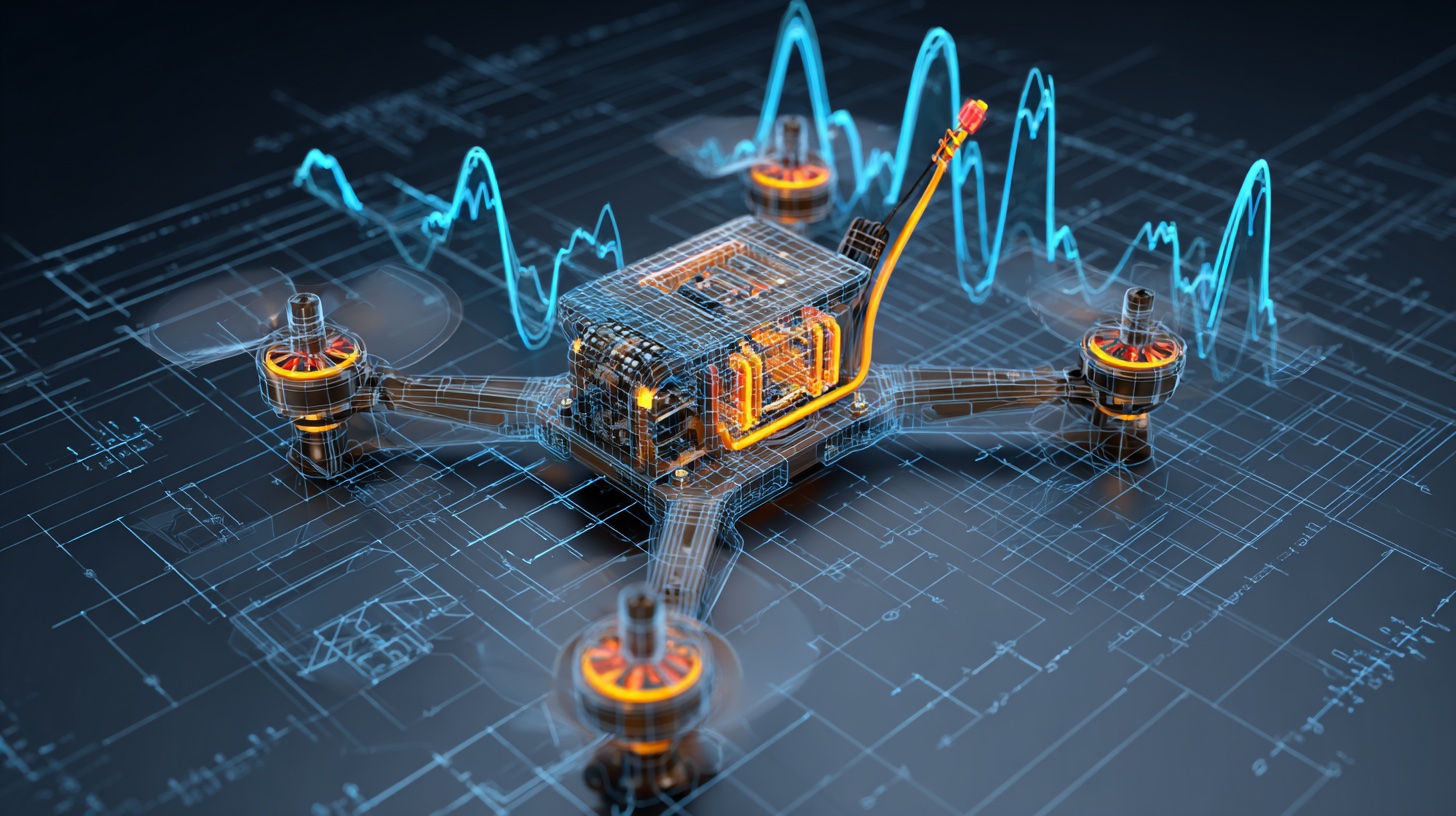
Understanding Notch Filters in FPV Flight Controllers
A notch filter represents one of the most powerful tools in your FPV tuning arsenal, specifically designed to eliminate unwanted motor noise frequencies that can destabilize your quad. This notch filter practical guide will walk you through the fundamental concepts and real-world applications that separate smooth-flying builds from oscillating nightmares. Motor noise manifests as high-frequency vibrations transmitted through your frame to the flight controller’s gyroscope, creating false readings that confuse the PID control system. When your flight controller receives these erroneous signals, it attempts to correct for movements that aren’t actually happening, resulting in oscillations, reduced flight time, and poor handling characteristics. Understanding this relationship between mechanical vibrations and electronic filtering forms the foundation of effective notch filter implementation.
Modern flight controllers like Betaflight incorporate sophisticated digital signal processing capabilities that allow precise frequency targeting through notch filters. These filters work by creating deep nulls at specific frequencies while leaving surrounding frequencies relatively untouched, making them ideal for eliminating narrow-band motor noise without affecting overall flight performance. The key advantage of notch filters over traditional low-pass filters lies in their surgical precision – they can remove problematic frequencies without introducing the phase lag and response delays associated with broader filtering approaches. This selectivity becomes crucial when dealing with high-performance racing quads where maintaining crisp stick response remains paramount while eliminating destabilizing noise.
Motor Noise Frequency Identification Techniques
Successful notch filter implementation begins with accurate identification of your quad’s specific motor noise frequencies, which vary based on motor size, propeller selection, frame resonance characteristics, and mounting techniques. The most reliable method involves using Betaflight’s built-in spectrum analyzer during actual flight conditions, as ground-based testing often fails to replicate the complex harmonic interactions present during dynamic flight maneuvers. Connect your quad to Betaflight Configurator, navigate to the Receiver tab, and enable the spectrum analyzer while performing various flight patterns including hover, forward flight, and aggressive maneuvers. Look for consistent peaks that appear across multiple flight scenarios – these represent your primary target frequencies for notch filtering. Pay particular attention to frequencies that correlate with motor RPM calculations, typically appearing as fundamental frequencies around 100-300Hz with harmonics extending into higher ranges.
Betaflight Notch Filter Configuration and Setup
Betaflight’s notch filter system provides multiple filtering options including dynamic notch filters that automatically track changing motor frequencies and static notch filters for targeting persistent noise sources. Access these settings through the Configuration tab’s Filter Settings section, where you’ll find separate controls for gyro and D-term filtering. The dynamic notch filter represents the most advanced option, using real-time frequency analysis to automatically adjust filter frequencies based on current motor RPM. Enable this feature by setting the dynamic notch filter range to cover your identified problem frequencies, typically between 150-600Hz for most 5-inch racing quads. The system continuously monitors gyro signals and positions notch filters at detected peaks, providing hands-off noise suppression that adapts to changing flight conditions and motor wear patterns.
Static notch filters offer precise control for targeting specific, unchanging noise sources such as frame resonances or electronic interference from other components. Configure these filters by entering the exact center frequency, filter width (Q factor), and filter depth based on your spectrum analysis results. A typical configuration might include a static notch at 180Hz with a Q factor of 4.0 to target a persistent frame resonance, combined with dynamic notch filtering covering the 200-500Hz range for motor noise suppression. Remember that each additional filter introduces computational overhead, so balance filtering effectiveness against flight controller processing capacity. Modern F4 and F7 processors handle multiple notch filters without performance degradation, but older F3 controllers may require more conservative filtering approaches.
Advanced Notch Filter Tuning Parameters
Fine-tuning notch filter parameters requires understanding the relationship between filter width, depth, and phase response characteristics that affect overall flight performance. The Q factor controls filter bandwidth – higher values create narrower, more precise filters that target specific frequencies without affecting nearby ranges, while lower values provide broader filtering at the expense of potentially impacting desired control frequencies. Start with moderate Q values around 3.0-5.0 and adjust based on noise suppression effectiveness and any negative impacts on stick response or flight characteristics. Filter depth determines how aggressively the notch attenuates the target frequency, with deeper filters providing better noise suppression but potentially creating more noticeable phase shifts. Monitor your quad’s response to rapid stick inputs after implementing notch filters, watching for any delays or oscillations that might indicate over-filtering or inappropriate frequency targeting.
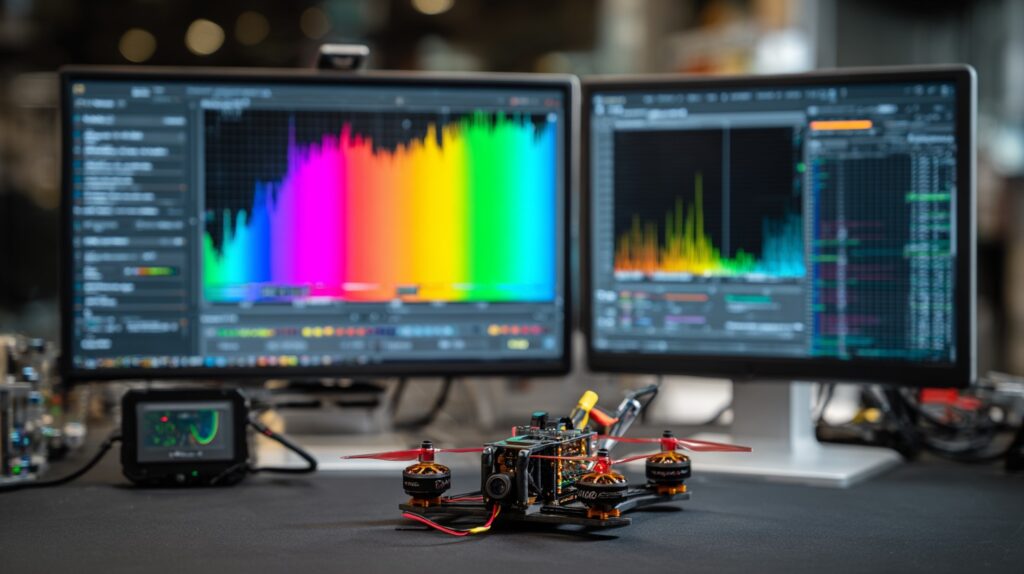
Betaflight’s spectrum analyzer helps identify target frequencies for notch filtering
Hardware Considerations for Notch Filter Effectiveness
While software filtering provides powerful noise suppression capabilities, addressing mechanical noise sources at the hardware level often proves more effective than relying solely on electronic filtering solutions. Proper motor mounting techniques, including the use of appropriate damping materials and secure fastening methods, significantly reduce the amplitude of vibrations reaching your flight controller. Soft-mounting your flight controller using silicone dampers or foam padding creates mechanical isolation that prevents high-frequency motor noise from coupling into the gyroscope sensors. However, be cautious with soft-mounting approaches, as excessive isolation can introduce unwanted delays and reduce the effectiveness of crash detection systems. The goal involves finding the optimal balance between vibration isolation and maintaining rigid mechanical coupling for accurate attitude sensing.
Frame design and construction quality play crucial roles in determining your quad’s noise characteristics and the effectiveness of notch filter implementations. Carbon fiber frames with proper structural design minimize resonant frequencies and provide better vibration damping compared to cheaper alternatives with poor joint design or inadequate material thickness. Pay attention to motor mount stiffness and the mechanical path between motors and flight controller – flexible or poorly designed mounts can create complex vibration patterns that prove difficult to filter electronically. Consider upgrading to higher-quality motors with better bearing systems and tighter manufacturing tolerances, as these components generate less inherent noise and provide more predictable frequency characteristics that respond better to notch filtering approaches.
Propeller Selection Impact on Filter Requirements
Propeller characteristics significantly influence motor noise patterns and determine optimal notch filter configurations for your specific build. Different propeller designs create varying aerodynamic loading patterns that translate into distinct motor noise signatures, requiring customized filtering approaches for optimal results. Aggressive racing propellers with steep pitch angles and sharp leading edges often generate higher amplitude noise across broader frequency ranges compared to more conservative designs optimized for efficiency and smooth operation. When changing propellers, always re-evaluate your notch filter settings using spectrum analysis to ensure continued effectiveness. The interaction between propeller aerodynamics and motor electromagnetic characteristics creates complex harmonic patterns that shift with different prop selections, making it essential to treat each propeller change as requiring potential filter reconfiguration.
Proper hardware mounting reduces motor noise and improves notch filter effectiveness
Troubleshooting Common Notch Filter Issues
Effective troubleshooting of notch filter problems requires systematic analysis of symptoms and methodical adjustment of filter parameters to isolate root causes. Oscillations that persist despite notch filtering often indicate incorrect frequency targeting or insufficient filter depth, requiring return to spectrum analysis for accurate problem identification. If your quad exhibits good performance in some flight modes but poor performance in others, consider that motor noise characteristics change with throttle position and flight dynamics, potentially requiring broader dynamic notch filter ranges or additional static filters targeting specific flight regime frequencies. Temperature-related performance changes suggest thermal effects on motor bearings or electronic components, creating frequency shifts that move noise outside your configured filter ranges.
Over-filtering represents another common issue that manifests as delayed stick response, reduced authority in rapid maneuvers, or inability to maintain tight control during aggressive flying. If you notice these symptoms after implementing notch filters, systematically disable filters one at a time to identify problematic configurations. Pay particular attention to filter interactions – multiple notch filters targeting closely spaced frequencies can create unexpected phase response characteristics that degrade overall system performance. The solution often involves consolidating multiple narrow filters into fewer, broader filters or adjusting filter placement to avoid frequency overlap. Remember that effective notch filtering requires balance between noise suppression and maintaining the crisp response characteristics that define high-performance FPV flight.
Frequently Asked Questions
How do I know if my FPV drone needs notch filtering?
Signs include visible oscillations in flight footage, hot motors after short flights, difficulty maintaining stable hover, or poor performance in windy conditions. Use Betaflight’s spectrum analyzer to identify noise peaks above 150Hz that correlate with motor RPM.
Can too many notch filters hurt flight performance?
Yes, excessive filtering can introduce phase lag and reduce stick responsiveness. Start with dynamic notch filtering and add static filters only for persistent, identified noise sources. Monitor flight characteristics after each filter addition.
Do different motor sizes require different notch filter settings?
Absolutely. Larger motors typically generate noise at lower frequencies (100-250Hz), while smaller motors create higher frequency noise (200-500Hz). Always use spectrum analysis to identify your specific motor’s noise signature.
Should I use notch filters on both gyro and D-term?
Start with gyro filtering as it addresses the root cause of noise-induced oscillations. Add D-term filtering only if you still experience high-frequency oscillations after implementing effective gyro notch filtering.
Ready to Optimize Your FPV Setup?
Implementing effective notch filtering can transform your quad’s performance, but every build presents unique challenges requiring personalized solutions. Our FPV tuning experts have helped hundreds of pilots eliminate motor noise and achieve buttery-smooth flight characteristics across all aircraft types. Whether you’re struggling with persistent oscillations, need help with spectrum analysis, or want to optimize your entire filtering strategy, we provide the expertise and hands-on support to get your quad flying its absolute best.