
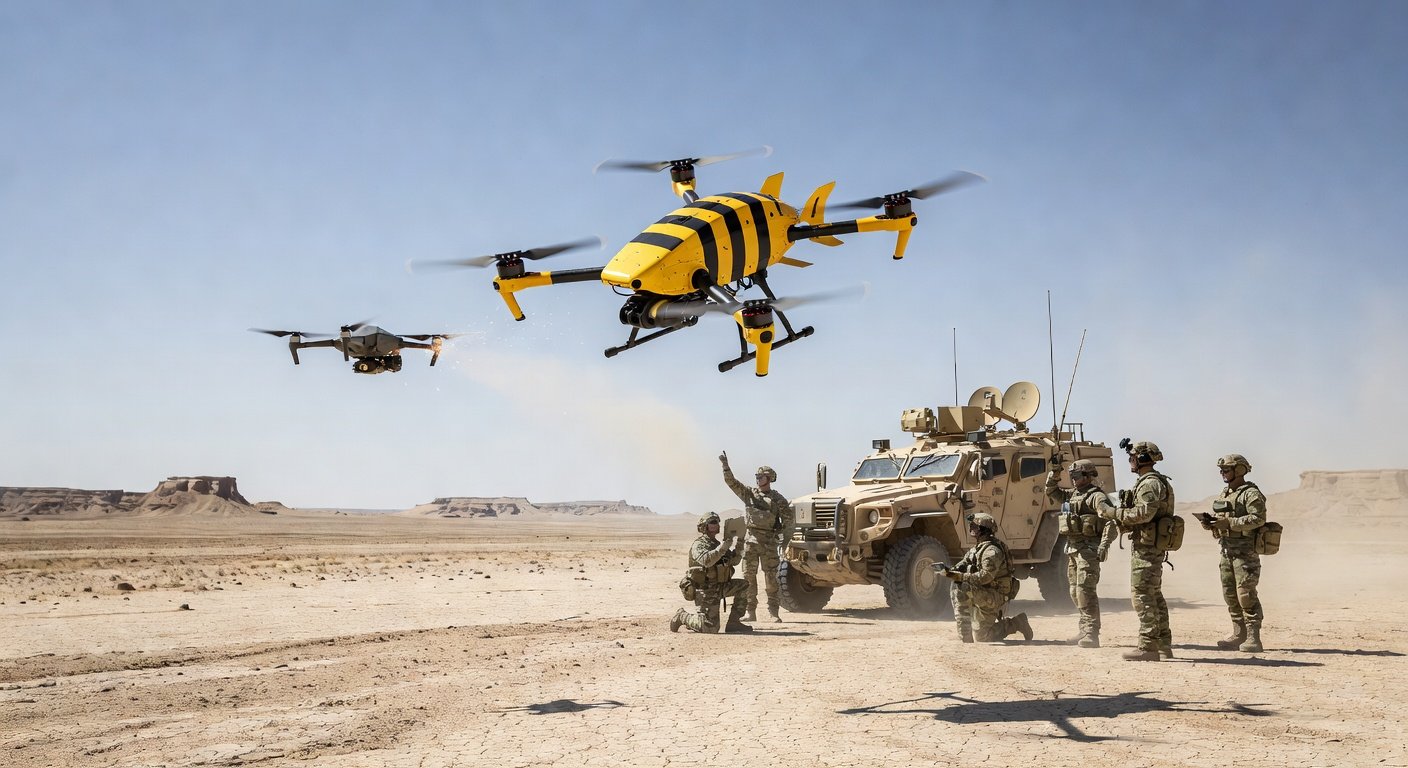
Bumblebee V1: Automated Interception for Hostile UAS
The US Army is serious about countering hostile drones, and their latest tool, the Bumblebee V1, is essentially a purpose-built FPV multirotor designed for physical interception. Developed by Perennial Autonomy in Menlo Park, California, this isn’t about jamming or nets; it’s about a controlled mid-air collision. The Bumblebee identifies a threat, closes the distance, and takes it out directly, meaning both aircraft go down. It’s a high-stakes, one-way trip for the interceptor, but a critical mission accomplished against an enemy UAS. Think of it as a low-cost, attritable solution to a persistent and growing problem.
The real differentiator for the Bumblebee V1 isn’t just that it’s an FPV multirotor, but its integrated autonomy suite. Trying to manually track a small, fast-moving hostile drone through goggles in a dynamic combat environment is an extremely difficult skill. The V1 offloads this burden to its software, automating target recognition and tracking. This means the operator can concentrate on tactical maneuvering and overall situational awareness while the system handles the precise intercept geometry. This capability frees up cognitive load, making drone-on-drone intercepts a more consistent and less training-intensive proposition for soldiers.
Field testing has confirmed the V1’s operational performance, demonstrating engagement ranges out to approximately 985 yards. Depending on flight conditions and speed, its battery endurance clocks in at around 20 to 25 minutes. Importantly, the platform is officially classified as a munition, which dictates its acquisition, storage, and deployment protocols. Both the V1 and the upcoming V2 are delivered as comprehensive systems, comprising the drone itself, battery, the full autonomy suite, FPV controls for manual override, a ground station with necessary antenna arrays, and integrated command and control software, ready for immediate operational use.
Beyond Interception: A Multirole Tactical Asset
During recent training at Fort Drum, New York, soldiers from the 10th Mountain Division quickly realized the Bumblebee was far more versatile than a dedicated counter-UAS tool. Lt. Col. Max Ferguson, the 10th Mountain’s director of operations, emphasized its surprising multirole capabilities. They found it adept at short-range reconnaissance, identifying both ground and air threats, deploying launched effects, performing one-way attack missions, and even delivering ordnance. This kind of flexibility from a single, low-cost platform offers tactical options they previously lacked entirely for small units like squads and platoons.
Historically, real-time aerial reconnaissance for a squad leader meant lengthy coordination with higher command, introducing significant delays into tactical decision cycles. With a Bumblebee, a squad can launch its own scout, rapidly assess terrain, pinpoint enemy positions, and adjust movements without waiting for external support. Spc. Cevyn Jay Paydy of the 4th Battalion, 31st Infantry Regiment, highlighted a critical benefit: the system keeps soldiers out of close-quarters clearing operations in fortified positions, which traditionally generate high casualties. Sending in a Bumblebee first fundamentally changes the risk calculation for assaulting a prepared enemy position, a direct impact on soldier safety.
Rapid Acquisition Fuels V2 Rollout and Battlefield Lessons
The current V1 training at Fort Drum runs parallel to the Joint Interagency Task Force 401 (JIATF-401) simultaneously fielding the upgraded Bumblebee V2. JIATF-401, the Department of War’s lead counter-drone organization, awarded Perennial Autonomy a $5.2 million contract for V2 systems on January 30, 2026, with deliveries kicking off swiftly in March of that year. The V2 brings significant upgrades over the V1, including a three-camera array with an improved gimbal, enhanced sensors, and a more robust automated target recognition system. This rapid procurement and deployment timeline represents a significant shift from traditional military acquisition processes, which often drag on for years.
Brig. Gen. Matt Ross, director of JIATF-401, stressed the broader importance of these systems, calling counter-drone capabilities vital for both battlefield operations and homeland defense. JIATF-401 isn’t just building a single-theater solution; they’re establishing a layered counter-drone architecture spanning combat zones, critical infrastructure protection, and interagency cooperation with groups like Customs and Border Protection and the FAA. The V1’s proven combat record in Ukraine directly informs the V2’s development, thanks to a rapid prototype transfer pipeline. This means operational lessons about intercept geometry, battery management, and target behavior from Ukrainian drone operators are directly shaping how American soldiers train, accelerating real-world application.
Quick Facts
- •💡 The Bumblebee V1 is a small FPV multirotor built by Perennial Autonomy for physical counter-UAS interception, colliding with hostile drones.
- •💡 The V1 features automated target recognition and tracking, with an engagement range of ~985 yards and 20-25 minutes endurance.
- •💡 Pilots benefit from the V1’s autonomy offloading tracking, letting them focus on maneuvering and situational awareness in combat environments.
- •💡 The system is classified as a munition and delivered as a complete package including drone, autonomy, FPV controls, ground station, and software.
- •💡 The V2, with a $5.2 million contract awarded Jan 30, 2026, includes a three-camera array, improved gimbal, and enhanced automated target recognition, with deliveries starting March 2026.