
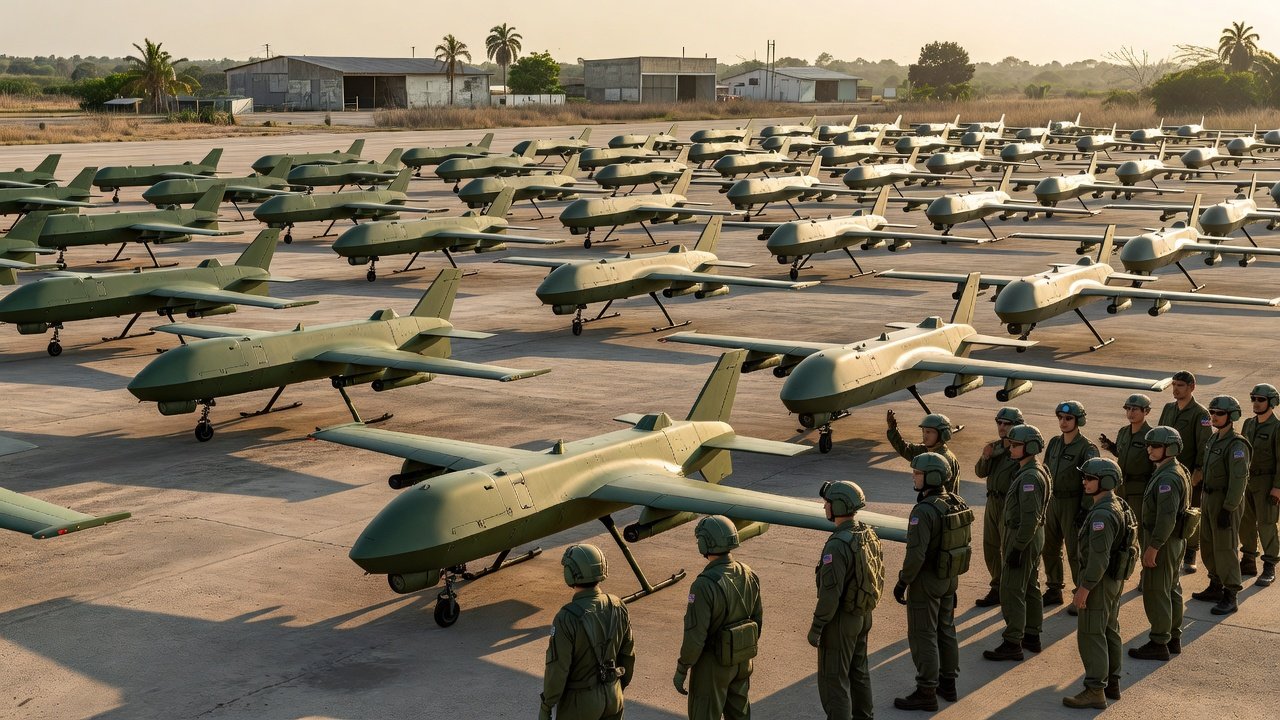
The Cuban Drone Stockpile: Shaheds and Mohajers 90 Miles Out
If you build quads and follow international drone news, you already know the Shahed-136 is the most exported one-way attack drone since 2022. A new Axios report claims Cuba now holds over 300 of these systems plus Iranian Mohajer-6s and Russian copies, all within 90 miles of Key West. The sourcing is a single senior Trump official, so treat the number with hobbyist skepticism—but the underlying pipeline is documented.
Iran’s Shahed-136 has a 2,000 km range and a small warhead, guided by a simple GPS and inertial navigation system. It’s basically a mass-produced flying wing with a cheap flight controller—think of it as a disposable Zorro-sized platform, only bigger and louder. The Mohajer-6 is a MALE drone with optical payloads, more like a long-range FPV wing with a camera gimbal.
Cuba acquired these drones since 2023 according to the report, stashing them in strategic locations. The Russian half of the pipeline is linked to Moscow sharing upgraded Shahed components with Tehran after field-testing them over Ukraine. If you’ve been following the ELRS and Crossfire frequency wars, this is the military equivalent—protocols and tactics being iterated in real combat.
What concerns FPV builders is that these are not static stockpiles. U.S. officials estimate 5,000 Cuban soldiers fought in Ukraine, some returning with direct drone warfare experience. That knowledge—how to set up ground stations, manage VTX interference, and execute coordinated attacks—is the real force multiplier behind the hardware numbers.
Counter-Drone Math: Why Key West Exercises Matter
Geography changes everything. Key West is 90 miles from Havana—straight line. A Shahed-136 cruising at 100 mph covers that in under an hour. The U.S. Navy ran FLEX 2026 off Key West last month, pairing a Vanilla surveillance drone with Textron TSUNAMI USVs and an Invariant STAKE rocket system to find and engage aerial targets. The official story was counter-narcotics; the real mission set is obvious.
The STAKE rocket system is a small, low-cost interceptor—basically a hobby-sized rocket with a proximity fuse. From an FPV perspective, it’s like shooting down a 5-inch quad with a model rocket. The exercise proved the kill chain works, but the economics are grim: each PAC-3 Patriot missile costs over $1 million. A Shahed costs maybe $20,000 in mass production. That’s a ratio even a budget builder can recognize as unsustainable.
Iran used exactly this approach against Israel in early March, burning through 800+ PAC-3s in three days. Cuba’s 300 drones, if launched in waves, would stress any defensive network. For FPV pilots operating near Florida, this means potential TFRs over the straits, frequency sweeps, and increased military air traffic. Know your NOTAMs before flying near the coast.
The Vanilla drone used in FLEX is a long-endurance fixed-wing, similar to a huge FPV glider. It can loiter for days, relaying targeting data. If you fly long-range wings, you understand the dynamics: persistence beats speed. The U.S. is building its own loitering capability to match what Cuba now holds.
What This Means for the FPV Community
For the average FPV pilot, this isn’t a call to panic—it’s a call to stay informed. The Axios story is the first public admission that Cuba has both the hardware and the trained operators to threaten U.S. assets at close range. Whether the 300 number is exact or rounded up, the trajectory is real. Builders who follow military tech already knew about the Shahed pipeline; now it’s on our doorstep.
Airspace is the biggest immediate impact. After the January raid in Venezuela, we saw TFRs over parts of the Caribbean. Expect similar restrictions if tensions rise. Check your local NOTAMs and avoid flying near military installations or coastal corridors between Key West and Havana. Your 5.8 GHz VTX might interfere or be interfered with by military datalinks—consider using lower-power bands if you must fly near potential exclusion zones.
On the tech side, watch for releases of hobby-grade counter-drone gear. FPV jammer builds, detection modules, and even net launchers are becoming more common as the community responds to threats. But don’t weaponize your quad—leave that to the pros. Instead, use the knowledge to build more failsafes: GPS rescue, failsafe altitude, and frequency hopping protocols like ELRS are your friends.
The bottom line for FPV: this story confirms that drones are now a strategic asset, not just a hobby. The same components we use—flight controllers, VTXs, GPS modules—are being scaled and hardened for military use. Pay attention to signal intelligence and frequency coordination in your area. The Cuban drone situation is a reminder that our airspace is no longer empty, and our gear is part of a much larger picture.
Quick Facts
- •💡 Cuba has acquired over 300 military drones from Russia and Iran since 2023.
- •💡 Key West is only 90 miles from Havana, putting Cuba within Shahed-136 range.
- •💡 An estimated 5,000 Cuban soldiers fought in Ukraine, gaining drone warfare experience.
- •💡 The Shahed-136 has a range of 2,000 km and a small warhead, guided by GPS/INS.
- •💡 The U.S. Navy ran FLEX 2026 off Key West in April, testing a counter-drone kill chain.