
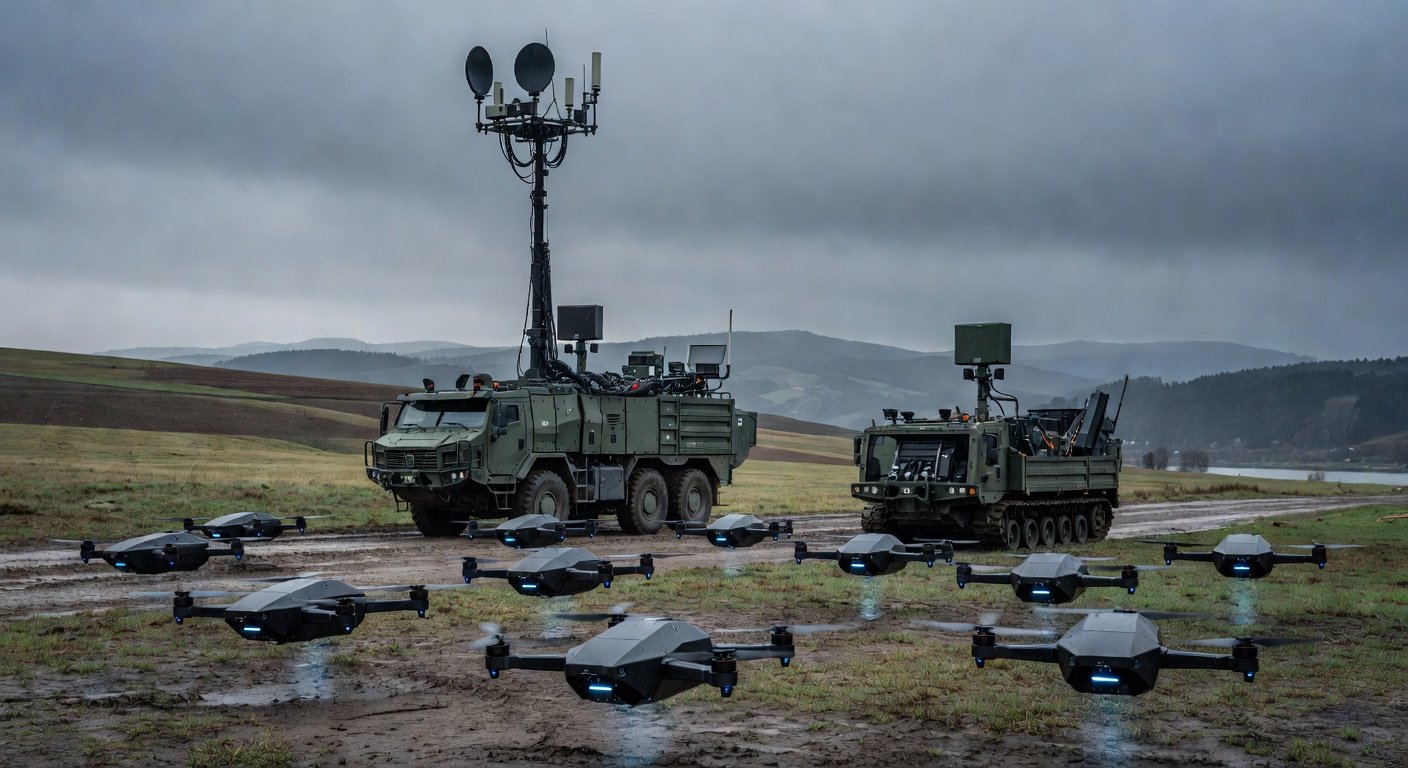
German Drone Shield Leverages Cellular Networks
Germany just announced a serious counter-drone initiative, teaming Rheinmetall, a heavy-hitter in defense, with Deutsche Telekom, their biggest mobile carrier. This isn’t some vaporware; it’s a joint drone defense shield combining Rheinmetall’s air defense hardware with Telekom’s cellular network and radio frequency (RF) sensors to protect critical infrastructure (KRITIS sites like airports, power plants, ports, and even military installations). For us pilots, this means an increasingly monitored airspace, especially around sensitive areas. The system aims to go beyond traditional point defense, leveraging Telekom’s widespread cellular footprint for broad-area detection. This partnership addresses a pressing need, especially after a year of repeated airspace incursions across Germany, showing that even non-state actors can severely disrupt operations.
The timing is crucial. Germany logged over 1,000 suspicious drone flights in 2025, a stark reminder of the challenge. We saw Munich Airport shut down twice in 24 hours in early October, stranding around 6,500 passengers. Berlin Brandenburg also went dark for almost two hours on October 31st. Interestingly, a classified Bild report later clarified that the Munich incidents involved military reconnaissance platforms, not your typical consumer quadcopter, highlighting the diverse threat spectrum. This joint effort isn’t just about stopping recreational flights gone wrong; it’s about a multi-threat approach, addressing everything from rogue FPV quads to more sophisticated, potentially malicious UAVs. The system will be showcased at the AFCEA security trade show in Bonn this week, so we’ll be looking for more details on its capabilities.
Telekom’s Widespread Detection Grid
Deutsche Telekom is bringing a massive, standing sensor network to this deal, which is huge for national-scale coverage. They’ve been running drone detection systems for German government clients since 2017 and even spotted illegal drone flights during the 2024 European Football Championship for the police. Their RF sensors are designed to be mounted directly on existing cellphone masts. This allows them to track the signals between drones and their controllers, accurately fixing the position of both the aircraft and the pilot. This method is particularly effective against the common radio links used by DJI hardware, which, let’s be real, dominates the European civilian drone market and accounts for a significant portion of the routine airspace incidents authorities deal with. This widespread coverage is a game-changer compared to localized detection units.
Beyond dedicated RF sensors, Telekom is pushing the envelope with research into whether the existing mobile network itself can identify drones by detecting unusual data traffic patterns. This work, in collaboration with Helmut Schmidt University in Hamburg, utilizes an Ericsson 5G standalone network on the university campus. If this approach scales, it’s a massive shift: every single cellphone tower in Germany could become a potential drone sensor, requiring no new hardware. The European Commission’s February 2026 drone action plan actually proposed a similar architecture at the EU level. As Tim Höttges, Telekom’s chief executive, put it, this is about taking responsibility with their expertise in connectivity, cloud, and data analytics to elevate drone defense to a new level, moving beyond just discussions to real action.
Rheinmetall’s Kinetic Layer & Future Implications
On Rheinmetall’s side, they’re bringing the kinetic punch, the effector layer to this system. Their counter-drone operations are housed within the Düsseldorf-based contractor’s Electronic Solutions division. This team is responsible for the Skyranger air defense turrets and their formidable 10-kilowatt laser system, which has been tested against drones at ranges up to one kilometer. In December 2025, they also formed a strategic counter-drone partnership with Hamburg police and the Hamburg Port Authority, tackling detection in notoriously difficult environments with dense radio traffic from shipping. As Rheinmetall chief executive Armin Papperger highlighted, the threat from drones is highly digital, so effective defense needs a robust combination of sensors, effectors, and secure communication networks, something FPV builders understand well when we consider our own complex builds.
This announcement comes after some interesting market dynamics; Papperger publicly questioned the military drone market as a potential ‘big bubble’ in September 2025. Five months later, Rheinmetall missed out on Bundeswehr loitering munition contracts worth potentially €4.3 billion, losing to German defense AI firm Helsing and Berlin-based Stark Defence after failing to deliver a working prototype of their FV-014 Raider strike drone. However, this civilian drone shield partnership falls under a different division, one with a solid track record in detection sensors and high-energy laser systems. This deal positions Rheinmetall squarely for the procurement wave sparked by Germany’s October 2025 federal police law, which explicitly authorized police to shoot down rogue drones, making it a critical capability. What this means for us FPV pilots is a rapidly evolving regulatory and technical environment. Detection and neutralization capabilities are becoming utility-grade infrastructure, not just military niche tech. We’ll be keeping a close eye on the AFCEA presentation for specifics on detection range, accuracy, and false-positive rates – details that will tell us if this is a 2026 capability or something further out.
Quick Facts
- •💡 Germany’s Rheinmetall and Deutsche Telekom partnered to create a national drone defense shield, integrating air defense hardware with cellular networks and RF sensors.
- •💡 The system aims to protect German KRITIS sites (critical infrastructure) following over 1,000 suspicious drone flights in 2025, including airport closures in Munich and Berlin Brandenburg.
- •💡 Deutsche Telekom’s existing RF sensors on cell masts track drone and controller signals, well-suited for DJI hardware, and new research with Helmut Schmidt University explores 5G network-based drone detection via data traffic patterns.
- •💡 Rheinmetall contributes kinetic effectors from its Electronic Solutions division, including Skyranger air defense turrets and a 10-kilowatt laser system tested up to one kilometer.
- •💡 This national-scale solution, driven by Germany’s October 2025 police law authorizing drone takedowns, signals a shift towards treating counter-drone capability as essential, utility-grade infrastructure, impacting future FPV flight regulations.