
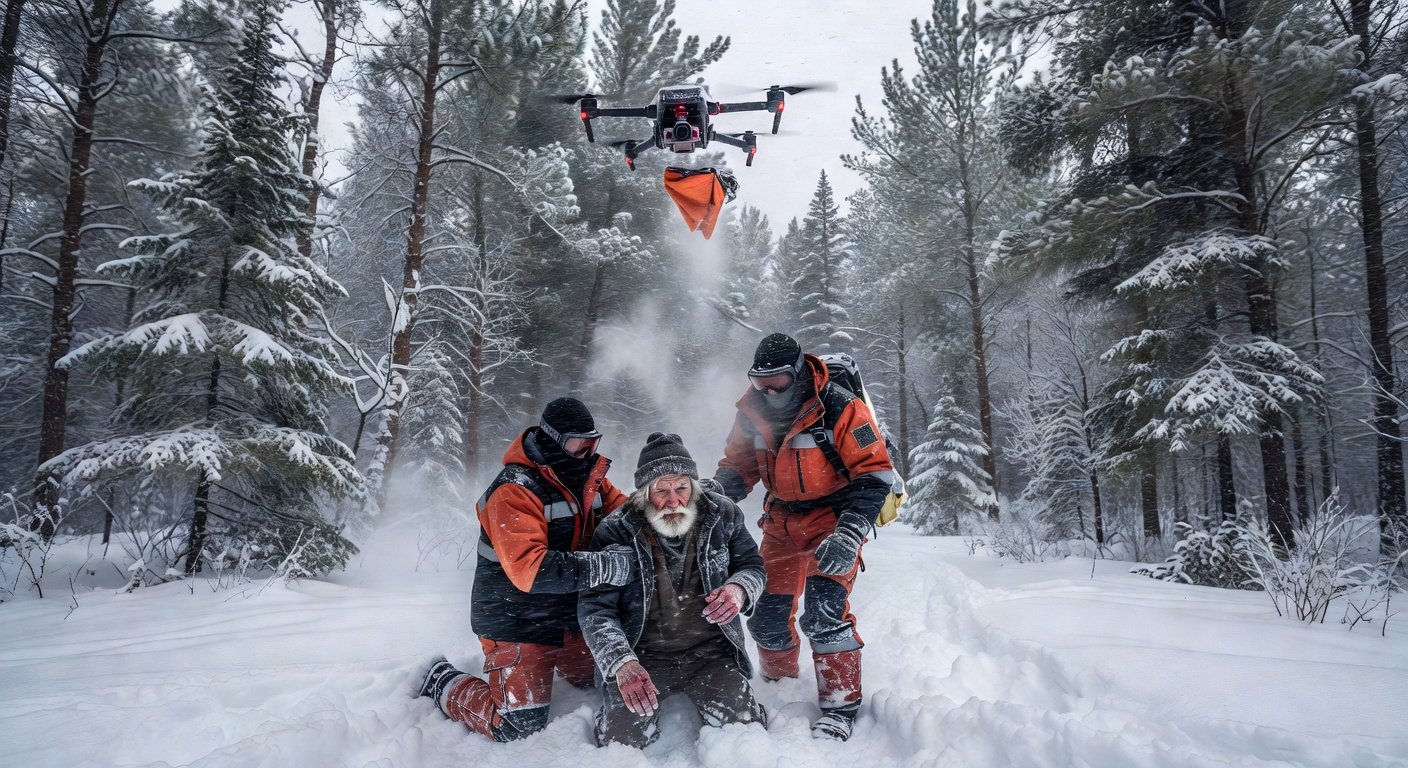
Rapid Deployment Saves Lives in Freezing Conditions
A ninety-one-year-old woman, missing from a residential care facility in Plover, Wisconsin, was located by a Portage County Sheriff’s Office thermal-equipped drone at 11:51 p.m. on May 5. This critical rescue happened roughly forty-three minutes after the initial call came in, with temperatures hovering just above freezing. The quick deployment and effective use of the drone were paramount, as the cold conditions posed an immediate threat to her survival after she’d wandered into a dense wooded area sometime after 9:45 p.m. This isn’t just a lucky break; it’s a testament to a well-resourced and well-trained public safety drone program.
The initial call reached the Portage County Sheriff’s Office Communications Center at 11:08 p.m. on Monday, May 5. While Plover Police Department officers arrived first, two critical assets from the Sheriff’s Office were also on shift: UAV-trained deputies. This detail is crucial for anyone involved in setting up or running a public safety drone program. Most rural and small-county departments rarely have two drone-rated deputies available on a late Monday night shift. The presence of these trained operators, ready to launch their platform when minutes truly mattered, allowed for an immediate aerial search, directly leading to the rapid and successful outcome.
Why Thermal Trumps Traditional Search in This Scenario
While K9 units are invaluable, this incident highlighted a common challenge: scent contamination. The facility’s caregivers, understandably desperate to find their missing resident, had already walked extensively over the property during their initial search. By the time the K9 arrived, the scent trail was compromised, rendering it less effective. This isn’t a failure of the K9 unit or the caregivers, but a critical procedural point in SAR: scent dogs need a clean trail, which civilians often unknowingly disrupt. For anyone building a robust SAR capability, understanding these limitations is as important as understanding equipment specs.
This is precisely where thermal imaging drones shine. Thermal cameras work by detecting temperature differences, making a person a clear ‘hot spot’ against a cold background. On a cool Wisconsin night, where ambient temperatures were between 32 and 40 degrees Fahrenheit, a ninety-one-year-old woman’s body heat would present a 30 to 50-degree delta. This significant difference paints her as a bright, unmistakable signature against the dark, cold ground, brush, and tree trunks. Moreover, thermal imaging bypasses visual clutter. Unlike standard visible-light cameras that rely on spotlights in dense woods at midnight, thermal payloads don’t need ambient light, allowing the pilot to locate the heat signature even if visual confirmation is impossible from above.
The Payoff: Investment in Capability and Training
The proliferation of public-safety drone programs in Wisconsin, with thermal-capable platforms now becoming a standard rather than a luxury, marks a significant shift from just five years ago. While the Portage County operators didn’t specify their drone model, systems like the DJI Matrice 300 RTK are prime examples of platforms offering robust thermal imaging capabilities. The hardware side has become more accessible, but the real differentiator for effective SAR programs today lies not in owning a capable drone, but in consistent training and ensuring adequate shift coverage with qualified operators. Simply having the gear isn’t enough; you need pilots who can deploy quickly and confidently under pressure.
Successful SAR outcomes are rarely about luck; they’re the direct result of strategic investments. The Portage County Sheriff’s Office clearly committed years ago to developing a thermal-capable drone program and ensuring enough trained operators were on staff to cover critical shifts, even late on a Monday. Had either the thermal capability or the trained personnel been absent, this story would likely have had a different, far grimmer ending. The K9’s hampered efforts weren’t the failure of the night, but rather the catalyst that propelled the drone into its critical primary role, demonstrating its unique advantage in such conditions.
For departments weighing their budget allocations, this case provides a powerful argument. The initial cost of a thermal-capable drone platform and the extensive training for multiple operators represents a substantial line item. However, as demonstrated by this incident, where a missing person was located and potentially saved from life-threatening hypothermia in just forty-three minutes, that investment can yield immeasurable returns. Portage County paid for this program before they desperately needed it, and on May 5, it delivered a complete return on investment, measured not in dollars, but in a human life.
Quick Facts
- •💡 A 91-year-old woman was found by a thermal drone in a wooded area in Plover, Wisconsin, on May 5, after going missing from a care facility.
- •💡 The rescue took 43 minutes from the initial call to location by the thermal-equipped drone; temperatures were just above freezing (32-40°F ambient).
- •💡 Thermal imaging works by detecting temperature differences, showing the missing person as a 30-50°F warmer signature against the cold background.
- •💡 K9 units were unable to track due to scent contamination caused by caregivers’ initial search efforts.
- •💡 The success highlights the critical importance of investing in both thermal-capable drone platforms and having multiple trained operators available for rapid deployment.