
FBI Counter-Drone Operations and Key Hubs for World Cup 2026
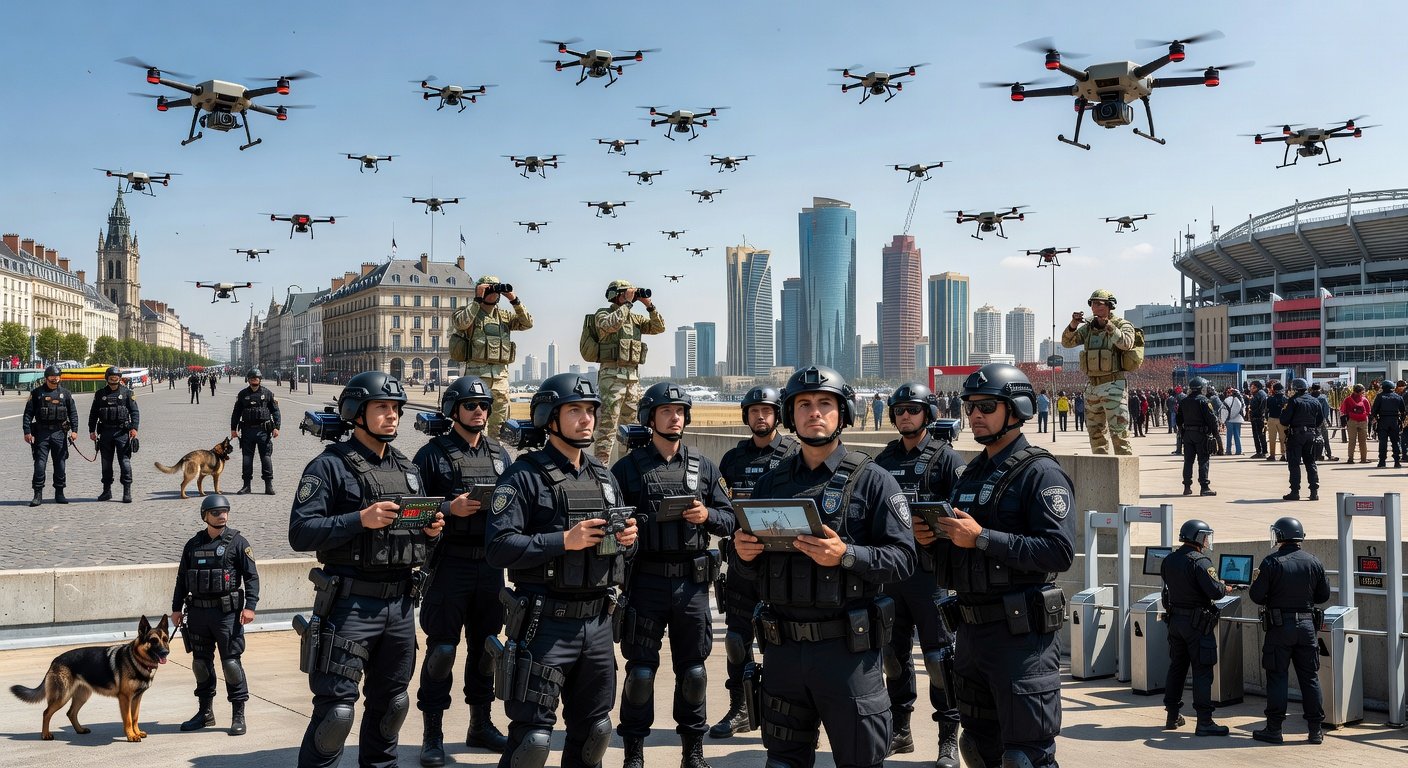
Heads up, pilots: the FBI is gearing up for World Cup 2026, deploying roughly 60 specially trained state and local police officers to detect and electronically disable hostile drones at venue sites. This small but focused force is split, with the FBI directly commanding counter-drone ops in Los Angeles, Miami, and New York, while Department of Homeland Security (DHS) components manage the other eight U.S. host cities. This 60-officer count aligns with what the bureau presented to Congress in April, indicating 45 officers were already certified, with a projected total of 61 before the tournament’s June 11 kickoff in Mexico City. For us, this finally clarifies who’s calling the shots on the ground and the limited pool of certified operators authorized to take down a rogue quad.
A recent training demo at Joe Davis Stadium in Huntsville, Alabama, showcased their approach. An operator launched a drone from about a mile (1.6 km) away, heading towards the soccer field. FBI teams, utilizing radar and radio-frequency (RF) sensors, electronically detected and tracked the drone, then successfully seized control without resorting to any kinetic methods. Michael Torphy, the FBI’s counter-drone training lead, made it clear: they want these operations to be ‘boring.’ Essentially, the goal is to silently neutralize threats, overriding the aircraft’s controls or forcing a land, rather than engaging with nets or other physical measures. This electronic focus means less chance of collateral damage from a drone being shot out of the sky, which is a good thing for everyone involved.
Electronic Mitigation & The Safer Skies Act’s Impact
These counter-drone defenses are purely electronic. Instead of firing nets, guns, or missiles, operators leverage radar and advanced RF sensors to pick up drones entering restricted airspace. Once detected, they disrupt or override the aircraft’s controls, forcing it down or seizing command. Importantly, local officers participating in the World Cup program are not authorized to use kinetic options, which are still part of the broader federal arsenal. This strategy was highlighted in a follow-up scenario where a hovering drone was met with a loudspeaker announcement: “This is the FBI. You have violated a no-fly zone. Land your drone immediately and await contact by law enforcement.” The drone then simply drifted off, underscoring the non-aggressive approach.
The legal framework for this expanded authority came late, with the Safer Skies Act, passed as part of the 2026 National Defense Authorization Act in December. This was a game-changer, extending drone mitigation authority to state, local, tribal, and territorial agencies for the first time. Previously, only the Justice Department and DHS held this federal power. Training for these officers flows through the FBI’s National Counter-UAS Training Center (NCUTC) at Redstone Arsenal in Alabama, a two-week flagship course. Without that certificate, an officer can’t operate mitigation equipment funded by the $250 million FEMA counter-UAS grant program rolled out for World Cup host states in January, highlighting the strict pipeline required for these specialized roles.
On-the-Ground Realities and What It Means for FPV Pilots
Despite the federal push, regional capabilities are still playing catch-up. For instance, NBC 5 Dallas-Fort Worth reported that Arlington Police, covering AT&T Stadium and nine World Cup matches, lack independent drone mitigation infrastructure just four weeks out. While one Arlington operator completed FBI training, the department will lean heavily on state and federal partners for real-time responses. Dallas Police, a key hub for fan travel, also has its federal agreement listed as ‘pending approval.’ A pool of 60 mitigation operators spread across 11 host cities, covering 104 matches over 39 days, works out to roughly five or six per city. Federal agents and contracted detection vendors will supplement this, but the certified-officer pool described is thin cover, especially given the sheer volume of anticipated airspace activity.
The threat justification for this buildout spans from a DJI Mavic 3 Pro causing a playoff game suspension in January 2025, to an explosives-laden drone plot in November 2024, and even a drone flown over a Trump rally in July 2024. The biggest shift in federal thinking, however, came from Ukraine’s June 2025 FPV drone strikes deep into Russian territory against strategic bombers. American officials now believe similar tactics could be replicated here. For us, the FPV community, this means stricter enforcement of NOTAMs and TFRs, particularly around stadiums and fan zones. With over 2,000 drone incursions annually at NFL stadiums, mostly from recreational pilots, a small mitigation force will likely be swamped with careless cases. It’s crucial for Part 107 operators to understand the evolving boundary between detect-and-track and disrupt-or-override, especially if operating outside a stadium TFR but within broader protected airspace, as this could lead to unintended interactions with federal mitigation efforts. Stay informed and fly responsibly.
Quick Facts
- •💡 The FBI will deploy approximately 60 specially trained state and local police officers for counter-drone operations at FIFA World Cup 2026 venues.
- •💡 The counter-drone strategy is primarily electronic, using radar and RF sensors to disrupt or override drone controls, not kinetic methods for local officers.
- •💡 The Safer Skies Act, passed in December, expanded drone mitigation authority to state, local, tribal, and territorial agencies for the first time.
- •💡 The threat justification includes incidents like a DJI Mavic 3 Pro causing a game suspension and Ukrainian FPV drone strikes on strategic bombers.
- •💡 The limited force of 60 officers across 11 cities implies significant reliance on federal partners and contractors, potentially leading to challenges for Part 107 operators if boundaries are unclear.