
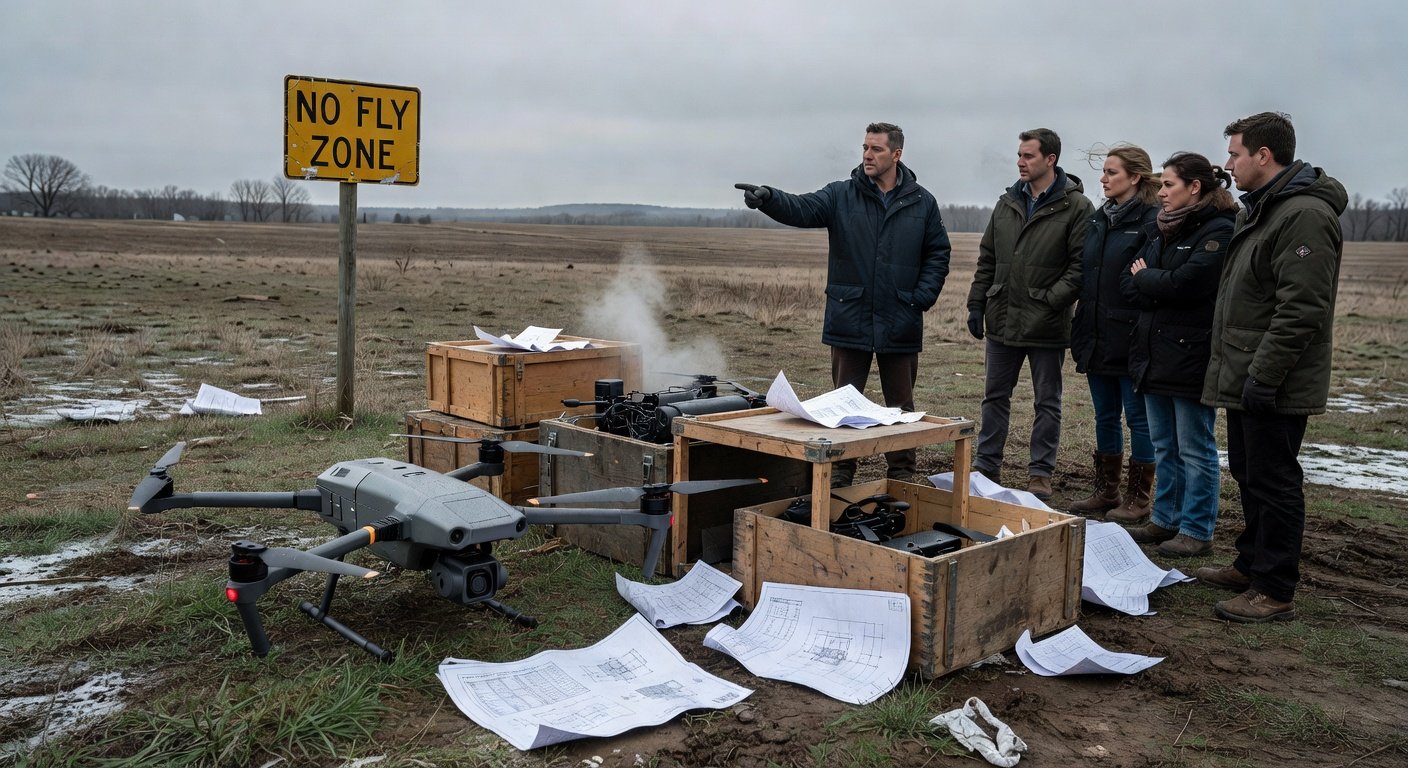
Michigan Passes Limited Drone Procurement Bills
The Michigan House just passed two out of fifteen proposed SHIELD drone bills, House Bills 5329 and 5331, sending them to the Senate this week. Both bills target one thing: stopping state agencies and public entities from spending state tax dollars on drones from companies on federal “concern” lists. We’re talking about the Department of Defense’s NDAA Section 1260H list of Chinese military companies and the Commerce Department’s Entity List. This means any state department needing a new quad or even a larger inspection drone for bridge work will be barred from buying DJI, Autel, or other Chinese-made aircraft, pushing procurement towards Blue sUAS-approved alternatives.
Specifically, HB 5329, sponsored by Rep. Josh Schriver, prohibits public entities from contracting to buy drones with software developed by entities on these federal lists, including the Chinese Military-Industrial Complex Sanction List. HB 5331, from Rep. Jennifer Conlin, complements this by banning the use of state funds for such purchases, amending the Management and Budget Act. Here’s the catch: the House Fiscal Agency confirmed that HB 5329 is legally tied to HB 5330, a cybersecurity standards companion bill, which hasn’t even passed the House yet. So, as it stands, one of the two “wins” is effectively inoperative until that third bill moves forward, making this initial step more symbolic than immediately impactful.
The Problematic ‘No Drone Zone’ Bills Remain Stalled
While procurement passed, the other thirteen SHIELD bills that would actually hit us FPV pilots hard are still sitting in the House. These are the contentious ones that were flagged months ago for likely federal preemption challenges. We’re talking about criminal penalties for flying over critical infrastructure, giving state and local police authority to disable or shoot down drones, a mandatory smartphone geofencing app for every operator, a standardized ‘No Drone Zone’ signage program, expanded trespass laws for drone flights, and a statewide MDOT-administered drone registry. These are the provisions that would fundamentally change how we fly in Michigan, making basic recreational or Part 107 operations a minefield.
Federal preemption is the big wall these bills keep hitting. Michigan’s own MCL 259.305 already prevents local governments from making their own drone rules, a line that was upheld in the 2022 Michigan Court of Appeals decision against Ottawa County. The SHIELD package tries to let the state do what local governments can’t, but several of the unpassed bills directly conflict with the FAA’s authority over airspace. The FAA’s July 2023 Office of the Chief Counsel fact sheet explicitly states that state and local laws regulating airspace face field preemption, echoing rulings like the 2017 Singer v. City of Newton federal court case that struck down similar local ordinances.
Rep. Bruck argued the December 2025 NDAA’s SAFER SKIES Act provides cover for police drone takedown authority. However, SAFER SKIES is narrowly defined, authorizing *trained* law enforcement to disable drones posing a “credible threat” at specific protected events or critical infrastructure. This is not a blanket authorization for generalized “no drone zone” enforcement or criminal statutes applied broadly to recreational and Part 107 operators. The difference is huge: it’s about targeted counter-UAS for specific threats, not giving every cop the green light to take down any quad in a perceived ‘no fly’ area.
What This Means for Michigan Pilots
Don’t let the press releases fool you. While House leadership is spinning this as a “House passage of his bipartisan S.H.I.E.L.D. Michigan plan,” only two of fifteen bills actually moved. Yahoo News, unlike the lead sponsor, correctly reported that HB 5329 and HB 5331 were just “the first two passed.” This distinction matters because it tells you which provisions even a bipartisan majority isn’t willing to push right now. Procurement restrictions on Chinese-made drones are politically easy and don’t clash with FAA preemption, making them low-hanging fruit. Authorizing police to shoot down quads or mandating a state geofencing app for everyone? That’s a different legal and political beast, and the legislature clearly knows it.
The real story for us FPV pilots is that the bills that actually would have made flying in Michigan a headache — the “no drone zone” criminal penalties, the police takedown authority, the mandatory state geofencing app, the expanded trespass rules — are currently stalled. Even after 18 months of drafting and bipartisan support, these harder bills couldn’t get a floor vote. The Michigan Coalition of Drone Operators, which has a track record of beating back bad drone legislation, has been on this package from day one, raising documented concerns about federal preemption and the critical distinction between negligent and malicious flying. Their efforts, and the inherent legal challenges, are clearly having an impact.
Quick Facts
- •💡 The Michigan House passed 2 out of 15 SHIELD drone bills (HB 5329 and HB 5331) on Tuesday, aimed at restricting state procurement of Chinese-made drones.
- •💡 HB 5329 and HB 5331 bar state agencies from buying drones from entities on federal lists like NDAA Section 1260H or the Commerce Dept’s Entity List, but HB 5329 is legally tied to HB 5330 (cybersecurity), which has not passed.
- •💡 The 13 SHIELD bills that did not pass included criminal “no drone zone” penalties, police drone takedown authority, and a mandatory state geofencing app, which would directly impact recreational and Part 107 pilots.
- •💡 Existing Michigan law (MCL 259.305) already prevents local drone rules, and federal preemption (FAA’s July 2023 fact sheet, 2017 Singer v. City of Newton ruling) limits state authority over airspace.
- •💡 The two passed bills are legally inert until their companion bill, HB 5330, also passes, and the remaining 13 problematic bills face significant legal and political hurdles, with no clear timeline for advancement.