
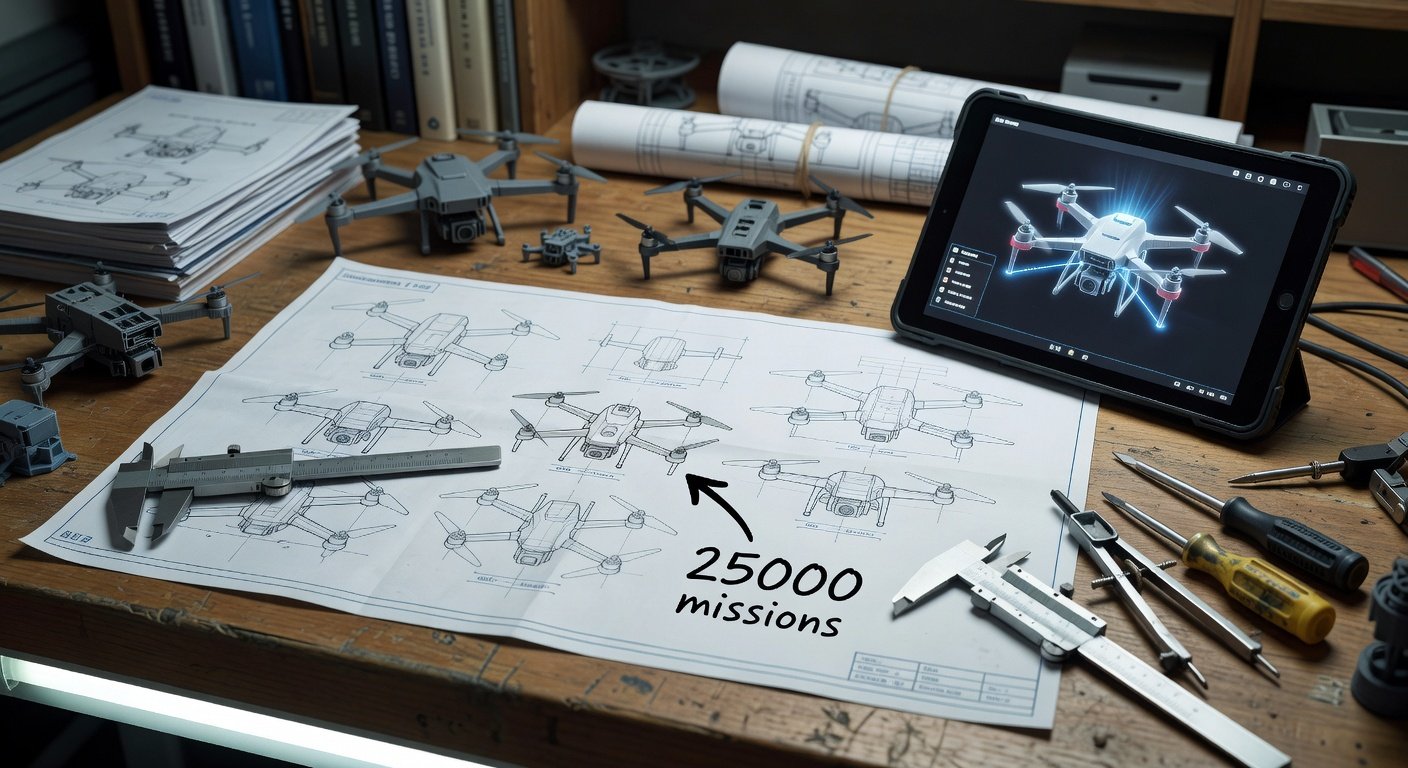
CVPD’s 25,000 DFR Missions: Proven Results at Scale
The Chula Vista Police Department’s Drone as First Responder (DFR) program just clocked over 25,000 missions since launching in 2018. This isn’t just another program; CVPD pioneered the DFR model, literally writing the playbook that other agencies across the country, from Fresno to Miami Beach, now follow. As of May 8, 2026, the numbers are stark: drones arrived on scene first for 17,170 calls, averaging a blistering 96.98 seconds ahead of ground units. These aren’t just feel-good stats; this is verifiable operational data, publicly available, demonstrating DFR’s undeniable effectiveness.
Breaking down those 25,000 missions further, CVPD’s drones played a role in 4,138 arrests, a significant assist to ground teams. Even more compelling, 4,629 calls were resolved or confirmed as requiring no further ground response, completely freeing up patrol officers. That’s nearly one in five missions clearing without a single officer rolling, translating into thousands of redirected patrol hours for higher-priority incidents. DFR has been deployed across a range of urban policing scenarios, from armed robberies and domestic violence to stolen vehicles, fires, and missing persons, proving its versatility and impact in critical situations like guiding officers to a man trapped in a burning car in October 2023.
The Gear & The Stack: Not Your Standard Setup
From day one in 2018, CVPD built its DFR backbone on DJI Matrice 200-series aircraft, manually launched from rooftops. These enterprise drones have remained the workhorse of their fleet, forming the foundation for the vast majority of those 25,000 missions. While Skydio 2 drones have been used in mixed roles, the core DFR operations and the massive mission count are attributed to the Matrice platform. These aircraft come equipped with serious payloads: high-definition optical zoom cameras for identification and plate reading, plus radiometric thermal cameras that are crucial for nighttime operations, structure fires, and locating subjects from altitude.
Interestingly, CVPD’s flight management and command-and-control stack isn’t running on the commonly cited Skydio DFR Command platform. Instead, they’ve implemented a Motorola-based integration, linking the live drone feed, dispatch workflows, and officer communications into a cohesive operational picture within their real-time operations center (RTOC). This detail challenges the prevailing vendor narratives about ‘default’ DFR stacks. Moreover, CVPD’s early involvement in the FAA’s Integration Pilot Project (IPP) in 2018 was a game-changer, granting them extensive Beyond Visual Line of Sight (BVLOS) waivers. These waivers are critical, allowing a single teleoperator to fly over Chula Vista neighborhoods without needing a visual observer on every flight, which is the only way a program scales to 25,000 missions.
Setting the Standard: What This Means for Drone Ops
CVPD’s success wasn’t accidental; it stemmed from deliberate operational decisions made early on. They published a detailed Concept of Operations (CoOP) document, which has since become the de facto template for other agencies. Crucially, they integrated community transparency from the outset with a public data portal, mitigating privacy concerns. The program was embedded directly into real-time crime center operations, not treated as an isolated experiment. And leadership, notably retired Captain Fritz Reber, viewed DFR as core infrastructure, not just a gadget. Reber’s subsequent move to Skydio as Head of Public Safety Integration further shows how CVPD’s operational concepts, BVLOS safety cases, and RTCC integration have directly shaped the wider DFR ecosystem.
The 25,000-mission milestone from CVPD unequivocally settles the debate: DFR is not a pilot program, not a demonstration, and not just a vendor’s pitch. It’s a fully integrated, eight-year operational reality proving measurable public safety value. Every police chief considering DFR is shown CVPD’s arrest-assist numbers and rapid response times. While legitimate discussions about aerial surveillance, data retention, and scope creep will and should continue, the foundational question of whether drone technology delivers tangible benefits is no longer in dispute. This volume of documented, audited operations means the conversation has shifted from ‘does DFR work?’ to ‘how will every other US city deploy their version of it?’ That’s the real takeaway from 25,000 missions.
Quick Facts
- •💡 Chula Vista PD’s DFR program surpassed 25,000 missions as of May 8, 2026, since its inception in 2018.
- •💡 Drones arrived first on scene in 17,170 missions, with an average response time of 96.98 seconds ahead of ground units.
- •💡 The program’s core operations have primarily utilized DJI Matrice 200-series aircraft, equipped with HD optical zoom and radiometric thermal payloads.
- •💡 CVPD employs a Motorola-based integration for its command-and-control stack, distinct from the commonly discussed Skydio DFR Command/Axon platforms.
- •💡 Extensive BVLOS waivers, secured through participation in the FAA’s Integration Pilot Project, allow a single teleoperator to manage flights over neighborhoods, enabling large-scale DFR operations.