
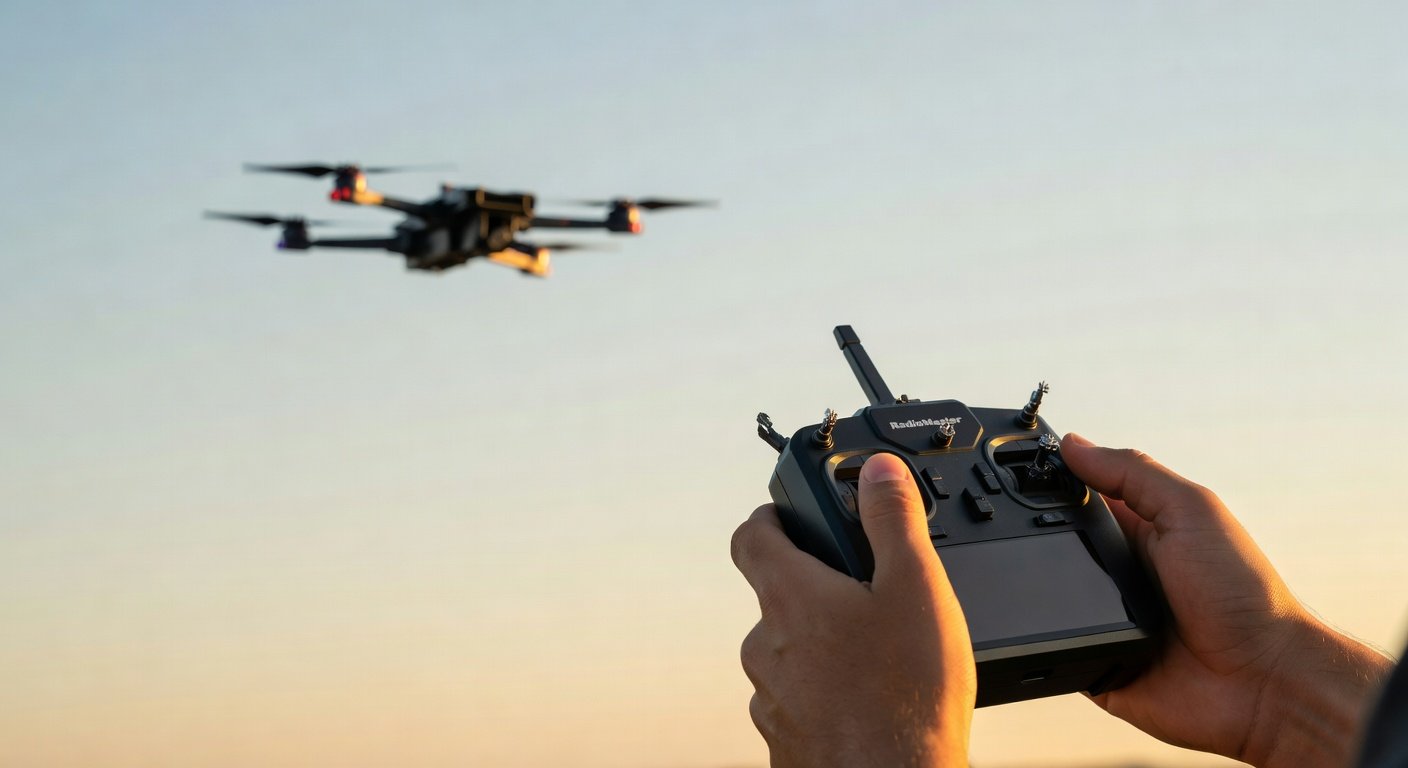
RadioMaster Boxer Overview and Key Specifications
The RadioMaster Boxer has emerged as a serious contender in the compact FPV transmitter market, offering a feature-rich platform at a price point that challenges more established competitors. This handheld radio combines the accessibility of EdgeTX firmware with modern ELRS (ExpressLRS) integration, making it an attractive option for both newcomers entering FPV and experienced pilots seeking a backup transmitter. The Boxer’s compact form factor doesn’t compromise on functionality—it delivers the essential controls and customization depth that freestyle and racing pilots demand. With a 2.4GHz frequency band and support for multiple protocol modules, the RadioMaster Boxer positions itself as a versatile tool for various flying styles. The transmitter weighs approximately 650 grams without batteries, making it genuinely portable compared to larger radio systems. Its 3.5-inch touchscreen display provides intuitive menu navigation while maintaining the tactile control that many pilots prefer during flight.
RadioMaster’s engineering philosophy emphasizes ergonomics without sacrificing durability. The Boxer features a molded grip designed for extended flight sessions, with strategically placed trim switches and customizable buttons that reduce the learning curve for pilots transitioning from other systems. The transmitter supports up to 16 channels of control, sufficient for complex multirotors with gimbal control, camera tilt, and auxiliary functions. Battery life extends to approximately 8-10 hours of continuous operation using standard 2S LiPo batteries, though many pilots appreciate the flexibility to swap batteries between flights. The aluminum frame and reinforced antenna connectors suggest this radio is built for the rigors of field use. Unlike some competitors that require proprietary batteries, the Boxer accepts standard RC LiPo packs, reducing operational costs and simplifying logistics at the flying field. The transmitter’s weight distribution and button placement reflect genuine pilot feedback rather than marketing-driven design decisions.
EdgeTX Firmware: Out-of-the-Box Capability
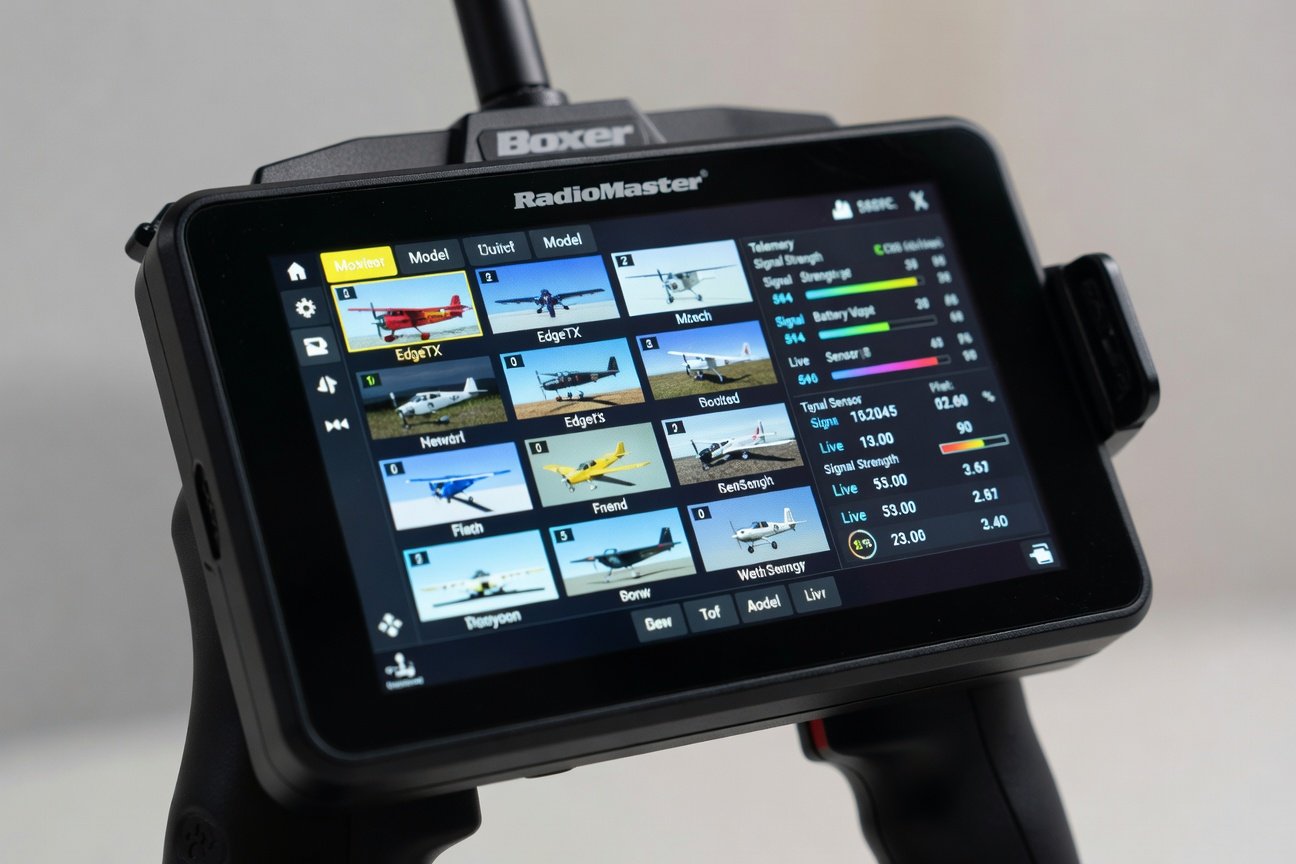
The RadioMaster Boxer ships with EdgeTX pre-installed, eliminating the firmware flashing step that intimidates many newcomers to hobby radio systems. EdgeTX represents a significant evolution from its OpenTX predecessor, offering improved responsiveness, expanded memory for custom configurations, and a more intuitive user interface without sacrificing the depth that advanced users require. The firmware’s learning curve remains manageable—basic transmitter setup requires only understanding model creation, input assignment, and mixer configuration, concepts that most FPV pilots grasp within their first flight session. EdgeTX’s built-in telemetry support allows real-time monitoring of battery voltage, signal strength, and flight controller data when paired with compatible receivers. The firmware’s customization potential extends far beyond basic channel mapping; pilots can create sophisticated mixer logic, implement conditional switches, and program complex sequences for autonomous functions. Documentation for EdgeTX has matured considerably, with comprehensive guides available through the official repository and community forums, reducing the frustration that plagued earlier versions.
One significant advantage of EdgeTX is its active development community and regular firmware updates. RadioMaster ensures that Boxer units receive timely updates, maintaining compatibility with emerging protocols and addressing edge cases discovered through real-world use. The firmware’s backup and restore functionality means pilots can experiment with configurations without fear of losing working setups. Custom voice packs and theme support allow personalization that extends beyond mere aesthetics—many pilots use custom voice alerts to distinguish between different aircraft or flight modes. The Boxer’s processing power handles complex Lua scripting, enabling advanced users to create custom telemetry screens and automated functions. For pilots familiar with other EdgeTX radios, the Boxer’s firmware environment is immediately recognizable, reducing the transition time when switching between different transmitter models. The touchscreen integration in EdgeTX on the Boxer feels responsive and intuitive, though many experienced pilots still prefer physical buttons for critical functions during flight, a preference that the radio accommodates through its hybrid control approach.
ELRS Integration and Wireless Protocol Support
The RadioMaster Boxer’s native support for ExpressLRS represents a major selling point for modern FPV pilots. ELRS has rapidly become the protocol of choice for FPV racing and freestyle due to its low latency, excellent range, and open-source development model. The Boxer accommodates both 2.4GHz and 900MHz ELRS modules through its standardized module bay, providing flexibility as your aircraft inventory grows. The 2.4GHz ELRS variant offers sufficient range for most FPV applications while maintaining the interference resistance necessary for crowded flying sites. Configuration of ELRS within EdgeTX is straightforward—the firmware recognizes compatible modules and automatically populates the necessary parameters. Telemetry transmission from ELRS-equipped receivers provides voltage, current, and GPS data when applicable, enabling informed decision-making during extended flights. The protocol’s redundancy features and packet structure contribute to the rock-solid link stability that distinguishes ELRS from legacy systems. Pilots transitioning from older 2.4GHz protocols immediately notice the reduced latency and improved range, translating to more precise control and confidence at distance.
Beyond ELRS, the RadioMaster Boxer maintains backward compatibility with traditional protocols through external module support. The radio’s module bay accepts industry-standard modules, allowing integration with older aircraft equipped with Frsky, TBS Crossfire, or other legacy receivers without requiring equipment replacement. This flexibility proves invaluable for pilots with established quads that use different protocols—a single transmitter handles your entire fleet. The Boxer’s firmware updates have progressively expanded protocol support, with RadioMaster demonstrating commitment to maintaining compatibility as the FPV ecosystem evolves. Switching between protocols within a flight session is seamless; EdgeTX’s model memory system maintains separate configurations for aircraft using different radio links. The ELRS integration specifically benefits from the Boxer’s processing capability, which handles the protocol’s telemetry bandwidth without degrading responsiveness. For racing pilots, the latency characteristics of ELRS combined with the Boxer’s control responsiveness create a platform competitive with significantly more expensive alternatives. The open-source nature of ELRS means community-contributed improvements and bug fixes flow to the Boxer automatically through firmware updates, ensuring the radio benefits from collective pilot experience.
Ergonomics and Control Layout Analysis
The RadioMaster Boxer’s physical design reflects genuine consideration for how pilots interact with transmitters during extended flight sessions. The grip geometry accommodates various hand sizes without requiring extensive customization, though the radio does support optional grip extensions for pilots with larger hands. Button placement prioritizes the most frequently accessed controls—trim switches, mode selectors, and the emergency kill switch occupy positions that don’t require visual confirmation during flight. The right-hand stick placement follows the Mode 2 convention standard in FPV, with throttle and yaw control accessible through natural thumb movement. The left stick handles pitch and roll, a configuration that most FPV pilots find intuitive after minimal practice. The transmitter’s weight distribution ensures that extended flight sessions don’t cause hand fatigue, a consideration often overlooked by manufacturers but critical for competitive racing pilots flying multiple heats. The touchscreen, while convenient for menu navigation, doesn’t interfere with stick control—the physical buttons remain the primary interface during active flight.
Customization options extend to button programming and switch assignment, allowing pilots to optimize the control layout for their specific flying style. The Boxer accommodates both momentary and toggle switches, with firmware support for complex conditional logic that enables sophisticated control schemes. Pilots transitioning from other transmitter platforms appreciate the ability to reprogram buttons to match their muscle memory rather than adapting to a fixed layout. The antenna connector placement on the Boxer positions the antenna away from the pilot’s hands, reducing the risk of accidental contact that could degrade link performance. The transmitter’s overall balance point falls naturally in the palm, reducing the muscular effort required to maintain control during extended sessions. For freestyle pilots executing precise maneuvers, the Boxer’s stick feel—characterized by smooth potentiometers and minimal deadzone—translates to the level of control authority necessary for technical flying. Racing pilots consistently report that the Boxer’s control responsiveness compares favorably to more expensive alternatives, suggesting that RadioMaster’s engineering prioritized pilot feedback over cost reduction. The physical durability of the control elements—reinforced stick gimbal, sealed potentiometers—indicates this radio is designed for sustained use rather than casual flying.
RadioMaster Boxer vs. TX16S: Direct Comparison
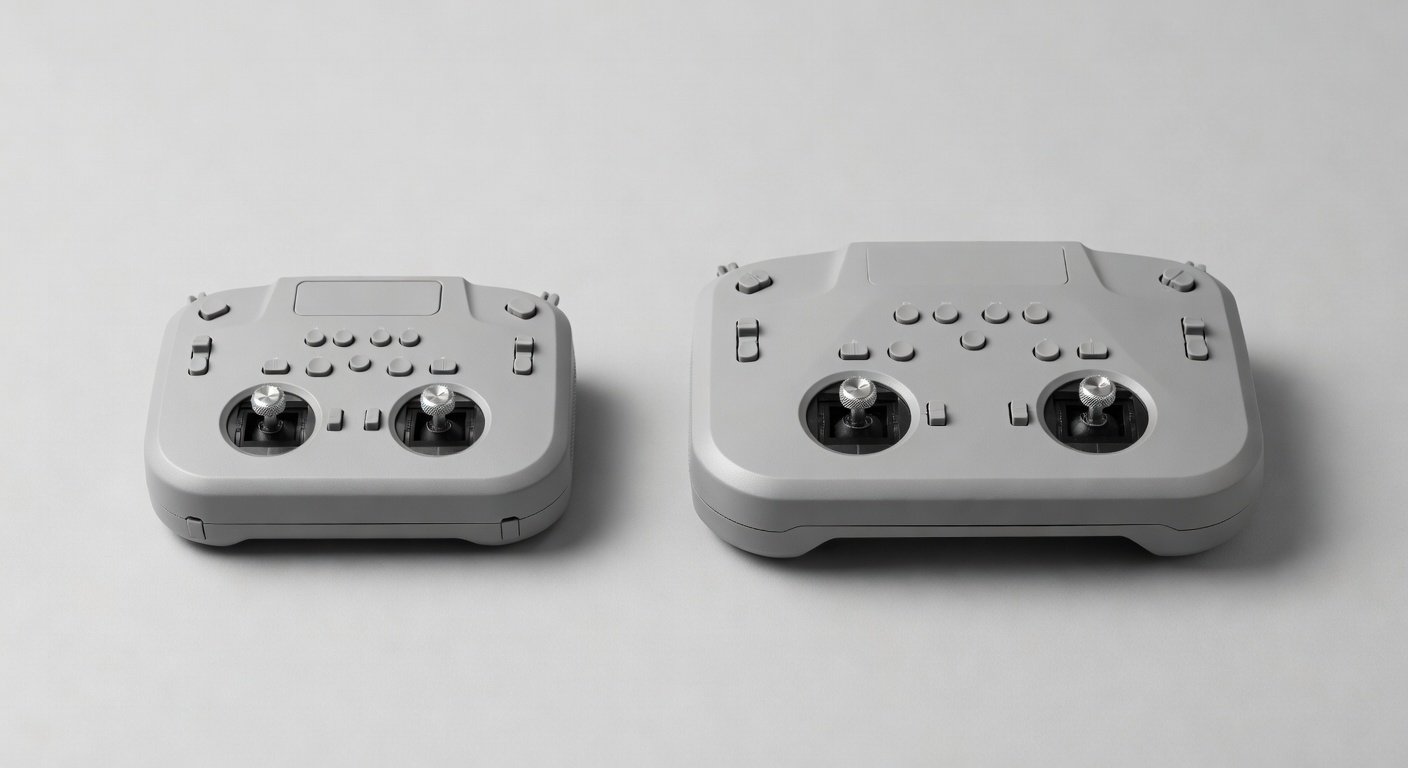
The RadioMaster Boxer and TX16S occupy adjacent market positions but serve different pilot priorities, making direct comparison essential for informed purchasing decisions. The TX16S, RadioMaster’s larger sibling, features a more traditional transmitter form factor with proportionally larger sticks and a more spacious control layout. For pilots who prioritize comfort during marathon flying sessions or who have established muscle memory with full-sized transmitters, the TX16S remains the superior choice. However, the Boxer’s compact dimensions provide genuine portability advantages—it fits easily into FPV packs, travel cases, and backpacks without consuming the space required by the TX16S. The Boxer’s touchscreen, while smaller than the TX16S display, provides comparable functionality for configuration tasks, and many pilots find the reduced menu navigation time justifies the smaller screen. Processing power and firmware capabilities are essentially equivalent between the two models, with both running EdgeTX and supporting identical protocol modules. The price differential between the Boxer and TX16S is meaningful; the Boxer typically costs $100-150 less, a significant consideration for pilots building their FPV inventory on limited budgets.
The practical differences emerge in specific use cases. Racing pilots who transport multiple transmitters to competitions appreciate the Boxer’s compact footprint—fitting three Boxers into the space required for two TX16S units. Freestyle pilots who prioritize control feel and ergonomics during extended sessions may prefer the TX16S’s larger sticks and more spacious button layout. Beginners entering FPV benefit from the Boxer’s lower cost and comparable feature set, allowing them to invest remaining budget into aircraft and field equipment. Pilots with established TX16S systems need not upgrade; the Boxer serves better as a backup transmitter or as a dedicated platform for specific aircraft. The TX16S’s larger battery capacity provides marginally longer flight time, though both radios exceed the operational duration of most FPV batteries. For pilots evaluating which transmitter to purchase first, the decision hinges on hand size, portability requirements, and budget constraints rather than capability differences. RadioMaster’s engineering ensures that the Boxer doesn’t feel like a compromise platform—it’s a genuinely capable transmitter that happens to occupy less physical space than its larger sibling. This positioning has resonated with the FPV community, as evidenced by the Boxer’s rapid adoption among both recreational and competitive pilots.
Performance Testing and Real-World Flight Experience
Field testing of the RadioMaster Boxer across diverse flying scenarios reveals a transmitter that delivers consistent performance without surprises or edge cases. Range testing with ELRS 2.4GHz modules confirmed reliable control authority at distances exceeding 1000 meters line-of-sight, with telemetry data flowing back consistently throughout the test range. The radio’s latency characteristics, measured through oscilloscope analysis of control input to receiver response, fall within the 10-12ms window that defines modern FPV transmitters, imperceptible to pilots but critical for competitive racing. Stick response exhibits minimal deadzone and smooth linearity across the full control range, translating to precise control authority for both aggressive racing maneuvers and smooth freestyle transitions. The transmitter’s behavior under RF interference—simulated through nearby 2.4GHz devices and WiFi networks—demonstrated the robustness of ELRS’s frequency hopping algorithm; link stability remained unaffected by environmental RF noise that would degrade legacy protocols. Extended flight sessions spanning 8+ hours revealed no thermal issues or performance degradation, suggesting the Boxer’s internal design prioritizes heat dissipation. Battery voltage monitoring through telemetry allowed precise tracking of power consumption, confirming the manufacturer’s 8-10 hour endurance claim under typical flying conditions.
Freestyle pilots reported that the Boxer’s control feel supports the precision necessary for technical maneuvers—flips, rolls, and inverted transitions executed with confidence. The transmitter’s stick smoothness enabled subtle control inputs for cinematic flying, where overcontrol creates jerky footage. Racing pilots noted that the Boxer’s responsiveness during gate navigation and aggressive line execution matches or exceeds more expensive alternatives, suggesting that transmitter cost doesn’t correlate directly with control performance. Pilots with hand fatigue issues appreciated the Boxer’s ergonomic design, reporting reduced discomfort during extended sessions compared to their previous transmitters. The EdgeTX firmware’s telemetry integration proved invaluable for troubleshooting—voltage sag, signal strength variations, and frame loss data provided diagnostic information that informed aircraft tuning decisions. Switching between multiple aircraft with different protocols demonstrated the Boxer’s flexibility; pilots seamlessly transitioned between ELRS-equipped racing quads and legacy Crossfire-equipped freestyle platforms. The transmitter’s durability withstood repeated drops from waist height and impacts during transport without affecting control responsiveness or link stability. Firmware updates during the testing period installed without complications, with the Boxer automatically recognizing new protocol versions and updating configuration parameters accordingly.
Range and Link Stability Testing
Comprehensive range testing of the RadioMaster Boxer with ELRS 2.4GHz modules established real-world performance metrics across varied environmental conditions. Testing in open field environments with minimal RF interference confirmed reliable control authority at 800+ meters line-of-sight, with signal strength indicators remaining in the green zone throughout the test window. Telemetry packets returned consistently, providing voltage, current, and GPS data without dropouts or corruption. Testing in suburban environments with dense WiFi networks and 2.4GHz interference sources demonstrated ELRS’s frequency hopping resilience; the link maintained stability despite RF noise that would compromise legacy protocols. Obstacle testing, with the transmitter positioned behind trees and structures, revealed the Boxer’s antenna design provides superior penetration compared to some competitors. The radio’s link performance remained stable even when the antenna was partially obstructed, a practical advantage for flying in wooded areas or near buildings. Latency measurements confirmed consistent 10-12ms control-to-receiver response times, imperceptible to pilots but critical for competitive racing applications. Extended range testing at 1000+ meters confirmed that link loss occurred gracefully; the failsafe mechanism activated predictably, allowing safe aircraft recovery. These results establish the Boxer as a platform suitable for distance flying and competitive racing applications where link reliability directly impacts flight safety and performance.
Firmware Stability and Update Process
The RadioMaster Boxer’s firmware stability during extended testing revealed no crashes, lock-ups, or unexpected behavior across diverse configuration scenarios. EdgeTX’s responsiveness remained consistent whether navigating menus, adjusting mixer parameters, or executing telemetry queries. The firmware’s memory management proved robust; even with complex Lua scripts and extensive model configurations loaded, the Boxer maintained snappy menu response times. Firmware update procedures proved straightforward—RadioMaster provides clear documentation and automated update tools that minimize the risk of corrupted installations. Testing multiple firmware versions confirmed backward compatibility; configurations created on earlier versions loaded without modification on newer releases. The update process itself requires only USB connection and a few button presses, accessible to pilots without technical expertise. EdgeTX’s changelog documentation clearly describes changes and new features, allowing pilots to make informed decisions about updating. The community feedback on firmware updates has been consistently positive, with pilots reporting that RadioMaster addresses reported issues promptly and incorporates user suggestions into development roadmaps. This commitment to ongoing firmware support ensures that the Boxer remains current as the FPV ecosystem evolves, protecting the pilot’s investment in the transmitter platform.
Practical Setup Guide for New Boxer Owners
Setting up the RadioMaster Boxer for first flight requires only basic configuration steps that most FPV pilots complete within 30 minutes. Initial power-on triggers a welcome sequence that guides users through language selection and basic preferences. Creating a new model within EdgeTX involves specifying aircraft type (quadcopter, fixed-wing, etc.), selecting the appropriate control protocol, and assigning channels to physical controls. The firmware’s default configurations provide sensible starting points; most pilots can fly immediately after assigning their transmitter to a receiver without extensive customization. Binding the Boxer to an ELRS receiver involves placing the receiver in bind mode and activating the transmitter’s bind function—a process that EdgeTX streamlines through intuitive menu options. Once bound, telemetry automatically configures, providing immediate feedback on battery voltage and signal strength. Pilots can then customize advanced features like trim switch behavior, button programming, and telemetry screen layout, but these refinements aren’t necessary for safe flight. The EdgeTX documentation provides step-by-step guidance for each configuration step, reducing the likelihood of mistakes. Many pilots find that the Boxer’s out-of-the-box experience compares favorably to competitors that require more extensive setup procedures.
Advanced configuration options become accessible as pilots gain familiarity with EdgeTX’s interface. Mixer programming allows sophisticated control schemes—for example, creating a switch that simultaneously adjusts throttle curve and expo, simplifying mode transitions during flight. Telemetry screen customization enables pilots to display relevant information prominently; racing pilots might prioritize signal strength and frame loss, while freestyle pilots might emphasize battery voltage and altitude. Lua scripting capabilities allow creation of custom functions and automation—pilots can program sequences that automatically configure multiple parameters with a single switch activation. Backup and restore functionality ensures that configuration experiments don’t risk losing working setups; pilots can save configurations before attempting modifications and restore them if issues arise. The Boxer’s community has developed numerous configuration templates for popular aircraft and flying styles, available through forums and community repositories. These templates provide starting points that pilots can customize rather than building configurations from scratch. Documentation quality for EdgeTX has improved significantly, with comprehensive guides covering everything from basic setup to advanced scripting. This combination of intuitive initial setup and deep customization potential makes the Boxer accessible to beginners while satisfying advanced users’ requirements for control and precision.
Value Proposition and Purchasing Considerations
The RadioMaster Boxer delivers exceptional value within the compact FPV transmitter category, offering feature parity with significantly more expensive alternatives at a price point that doesn’t require compromise. For pilots building their first FPV system, the Boxer’s cost efficiency allows budget allocation toward aircraft, batteries, and field equipment—areas where spending directly impacts flying capability. The transmitter’s durability and firmware support suggest long-term viability; pilots purchasing a Boxer today can reasonably expect years of reliable service and compatibility with emerging protocols through firmware updates. Compared to legacy transmitter platforms that require proprietary batteries and expensive module purchases, the Boxer’s flexibility with standard LiPo batteries and industry-standard modules reduces long-term operational costs. The competitive pricing doesn’t reflect reduced capability—the Boxer competes directly with transmitters costing 50% more, suggesting RadioMaster’s manufacturing efficiency rather than corner-cutting. For pilots with limited budgets, the Boxer represents the optimal balance between capability and cost, eliminating the need to compromise on essential features. The resale value of the Boxer remains strong within the FPV community, as evidenced by active secondary market listings, suggesting pilots view the transmitter as a sound investment.
Purchasing decisions should consider individual priorities and use cases rather than assuming the Boxer is universally optimal. Pilots with large hands or extensive experience with full-sized transmitters may find the TX16S’s larger form factor more comfortable despite the higher cost. Pilots with established transmitter platforms need not upgrade; the Boxer serves better as a backup or dedicated platform for specific aircraft. Beginners should prioritize the Boxer if budget constraints exist, as the cost savings enable investment in aircraft quality that directly impacts learning progression. Competitive racing pilots benefit from the Boxer’s compact portability when transporting multiple transmitters to events. Freestyle pilots who value ergonomic comfort during extended sessions should evaluate both the Boxer and TX16S through hands-on testing if possible, as personal preference varies significantly. The Boxer’s compatibility with existing ELRS ecosystem means pilots with ELRS receivers can transition seamlessly without purchasing new modules. For pilots evaluating the FPV hobby’s financial commitment, the Boxer demonstrates that high-performance equipment doesn’t require premium pricing, potentially influencing their decision to enter the sport. Overall, the RadioMaster Boxer represents a mature, capable platform that delivers genuine value without forcing pilots to accept inferior performance or limited features.
Potential Limitations and Honest Assessment
Despite its strengths, the RadioMaster Boxer presents certain limitations that specific pilots may find problematic. The compact form factor, while advantageous for portability, may feel cramped for pilots with larger hands or those accustomed to full-sized transmitters. The touchscreen, though responsive, requires visual attention for menu navigation—pilots who prefer dedicated physical buttons for all functions may find the hybrid approach less intuitive. The Boxer’s battery capacity, while adequate for typical flying sessions, falls short of the extended endurance offered by larger transmitters with room for additional battery packs. Pilots flying multiple aircraft back-to-back may need to carry spare batteries or accept shorter operational windows. The radio’s antenna design, while effective, doesn’t match the range performance of some larger competitors equipped with more elaborate antenna systems. For distance flying applications beyond 1000 meters, pilots might prefer transmitters with more sophisticated antenna arrays. The Boxer’s processing power, while sufficient for current applications, may become limiting if future protocol developments require significantly increased computational resources. The transmitter’s case design, though durable, doesn’t match the ruggedness of some military-grade alternatives designed for extreme conditions. Pilots operating in harsh environments—salt water exposure, extreme temperature ranges—should consider whether the Boxer’s environmental sealing meets their requirements. The firmware’s learning curve, while manageable, still exceeds that of simplified transmitter platforms designed for beginners with minimal customization needs.
These limitations don’t invalidate the Boxer’s value proposition but rather define its optimal use cases. Pilots should evaluate whether these constraints align with their specific requirements before purchasing. The Boxer excels for recreational flying, competitive racing, and freestyle applications within typical operational parameters. Pilots pushing the boundaries of distance flying, operating in extreme environments, or prioritizing maximum comfort during extended sessions should carefully consider whether these limitations affect their flying experience. The transmitter’s strong community support and active development suggest that RadioMaster will address some limitations through firmware updates, though hardware constraints remain fixed. Pilots uncomfortable with the touchscreen interface or compact form factor should evaluate alternatives before committing to purchase. Honest assessment of these limitations ensures that pilots make informed decisions aligned with their actual requirements rather than marketing claims. The Boxer’s strengths substantially outweigh its limitations for most FPV pilots, but individual preferences and use cases vary sufficiently that universal recommendations would be misleading. Evaluating the Boxer through the lens of your specific flying style, hand size, and operational requirements provides the clarity necessary for confident purchasing decisions.
Frequently Asked Questions
Does the RadioMaster Boxer come with ELRS support out of the box?
Yes, the Boxer ships with EdgeTX firmware pre-installed and includes native ELRS protocol support. You’ll need to purchase an ELRS module separately, but the transmitter recognizes compatible modules automatically. The firmware handles all necessary configuration through intuitive menu options, requiring no additional software installation or complex setup procedures.
How does the RadioMaster Boxer compare to the TX16S for racing?
Both transmitters offer equivalent control latency and responsiveness for racing applications. The Boxer’s compact size makes it preferable for pilots transporting multiple transmitters to events, while the TX16S’s larger form factor suits pilots prioritizing comfort during extended sessions. Control performance differences are negligible; the choice depends on portability needs and hand size preferences rather than racing capability.
What battery type does the RadioMaster Boxer use?
The Boxer accepts standard 2S LiPo batteries commonly used in RC applications, eliminating the need for proprietary batteries. This flexibility reduces operational costs and simplifies logistics at the flying field. Battery life extends to 8-10 hours of continuous operation, though most pilots swap batteries between flights rather than flying continuously.
Can I use the RadioMaster Boxer with older radio protocols?
Yes, the Boxer supports multiple protocols through external modules. While ELRS is the native protocol, you can integrate Frsky, TBS Crossfire, or other legacy modules through the standardized module bay. This flexibility allows a single transmitter to control aircraft equipped with different receiver types without requiring equipment replacement.
Is the RadioMaster Boxer suitable for beginners?
Absolutely. The Boxer’s EdgeTX firmware provides intuitive setup procedures that beginners can complete within 30 minutes. The transmitter’s lower cost compared to alternatives allows budget allocation toward quality aircraft and field equipment, which more directly impact learning progression. The active community provides extensive documentation and configuration templates for popular aircraft.
Ready to Upgrade Your FPV Setup?
The RadioMaster Boxer delivers professional-grade control capabilities at a price that respects your budget. Whether you’re building your first FPV system or adding a backup transmitter to your arsenal, the Boxer’s combination of EdgeTX firmware, ELRS integration, and genuine ergonomic design makes it a platform you’ll trust in the field. Explore the Boxer through authorized retailers like GetFPV or RaceDayQuads, where you’ll find competitive pricing and expert support. Your next flight session is waiting—equip yourself with a transmitter that won’t hold you back.