
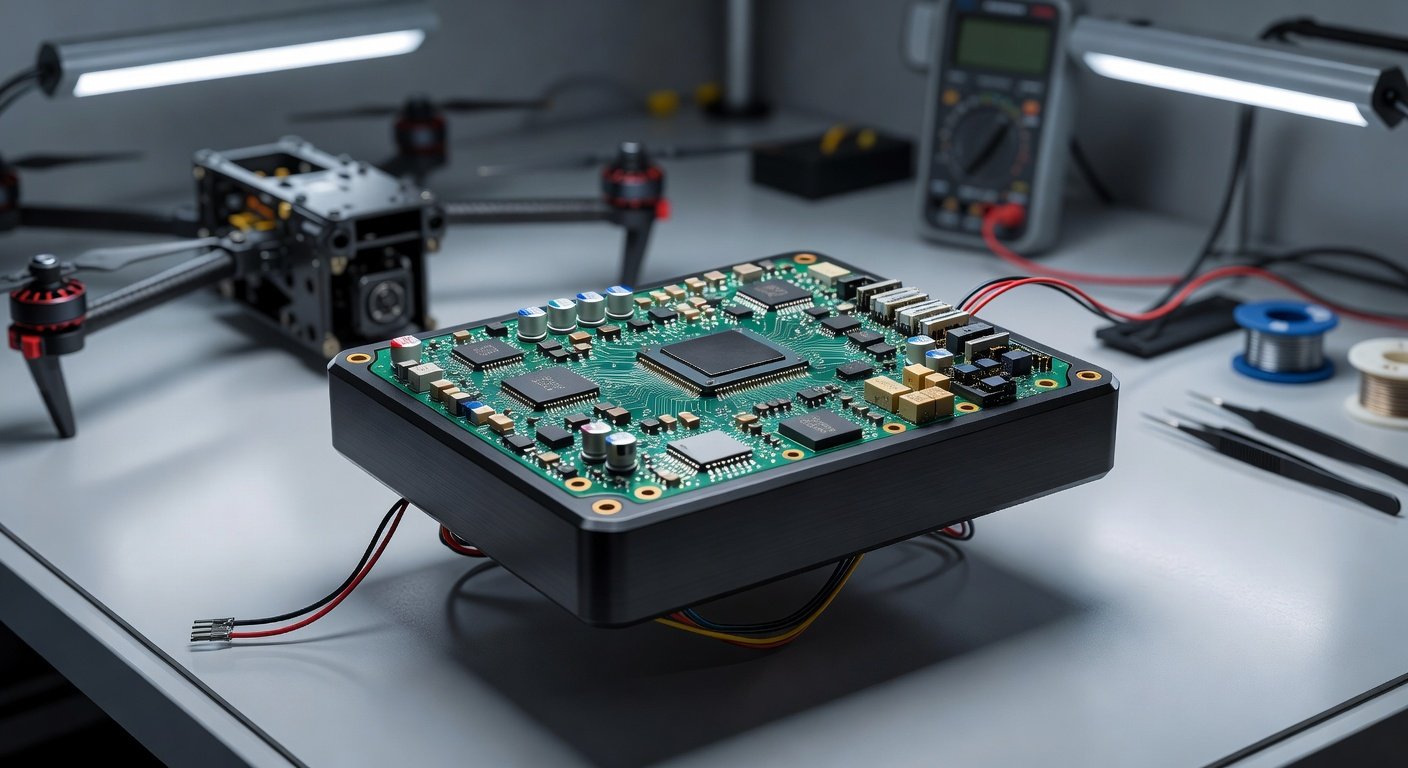
The HYFIX H1P Unpacked: U.S.-Made Precision
HYFIX Spatial Intelligence just dropped their H1P Positioning, Navigation, and Open-Compute Module, a critical piece of tech for U.S. drone builders looking to cut ties with overseas components. Samples and evaluation kits are available now, with a public showcase at AUVSI XPONENTIAL 2026. This isn’t just another GNSS module; it’s the first product built on their H1 Autonomous Systems Chip, designed and made in Santa Clara, California. For those of us dealing with tight stack space and power budgets, the H1P is a boon: it consolidates what used to be a half-dozen separate boards into a single surface-mount module. This simplifies complex builds, especially for smaller unmanned systems.
Under the hood, the H1P packs a serious punch as a GNSS positioning and navigation module with onboard compute. It boasts dual RF ports for native dual-antenna GNSS, with over 800 hardware tracking channels. That dual-antenna setup is huge for stable flight; it gives our quads true heading without relying on a magnetometer, which tends to drift in noisy electromagnetic environments. It supports every major global navigation satellite system, plus emerging low Earth orbit (LEO) signals like Xona’s Pulsar, which are stronger and more resilient to jamming. For centimeter-level accuracy, it integrates GEODNET real-time kinematic (RTK) correction data and IMU sensor fusion, ensuring clean navigation even when GPS signals get ugly.
Why it Matters: Supply Chain & Integration
The H1P arrives precisely when American drone manufacturers are under immense pressure to source domestically. The FCC’s Covered List and DoD guidance are tightening rules on foreign-made components, pushing builders towards U.S.-designed solutions. HYFIX is directly addressing this with their U.S.-designed H1 chip, aligning with a broader reshoring effort across airframe, motor, and battery suppliers. This effort is backed by a $15 million seed round from investors like Craft Ventures. The founding team, including CEO Mike Horton from autonomous tractors and co-founder Udan Ercan from high-precision GNSS at Topcon, brings serious pedigree to the table.
Traditionally, integrating full positioning, navigation, and compute requires patching together a flight controller, GNSS module, radio, and companion computer from different vendors. This leads to complex wiring, custom ‘glue code,’ and potential reliability headaches. The H1P collapses several of those layers into one part. It’s PX4 compatible and runs NuttX, which means existing software stacks don’t need a complete rewrite — a major benefit for small and mid-sized U.S. drone companies built on PX4. Plus, its open compute architecture allows developers to run their own custom logic on the dual-CPU setup, offering flexibility critical for specialized payloads or advanced autonomy development.
The Future for FPV Builders
The H1P directly tackles a significant gap in the U.S. drone industry: American silicon for autonomous systems. While domestic airframe and motor alternatives exist, the core intelligent components often still rely on overseas suppliers, undermining true supply chain independence. HYFIX is positioning the H1 chip as a platform, with plans to extend its architecture to humanoid robots and other industrial autonomous systems in the coming years. This suggests a long-term vision beyond just drones. Its adoption by drone builders over the next 12-18 months will be crucial to validate this strategy and determine if the U.S. can truly build out a robust, domestic autonomous hardware ecosystem.
Here’s the rub for us builders: HYFIX is a seed-stage company, and the H1P is currently in sampling, not full production. That crucial gap between evaluation kits and full-scale shipping has grounded many promising drone hardware projects. DJI’s formidable vertical integration, controlling their own silicon, sets a brutal benchmark, forcing U.S. builders to patch together disparate components. HYFIX offers a genuine, U.S.-made starting point for truly integrated systems. The real test is whether enough domestic drone companies commit to building around a young silicon vendor. Their adoption over the next two years will dictate if this move towards an independent, U.S.-centric supply chain genuinely takes flight.
Quick Facts
- •💡 HYFIX Spatial Intelligence launched the H1P Positioning, Navigation, and Open-Compute Module, with samples and evaluation kits available immediately.
- •💡 The H1P consolidates multiple boards into a single surface-mount module, featuring dual RF ports, native dual-antenna GNSS support with over 800 hardware tracking channels.
- •💡 This means true heading without relying on a magnetometer and centimeter-level positioning via GEODNET RTK, crucial for stable, precise navigation even with GPS issues.
- •💡 The H1 chip is U.S.-designed, addressing pressure on American drone builders to source domestically due to FCC Covered List and DoD guidance.
- •💡 The module is PX4 compatible and runs NuttX with an open compute architecture, allowing developers to run custom logic and potentially validating a U.S.-centric autonomous hardware supply chain.